
At Outset PR, we approach the question from the opposite direction: start with the business goal, determine the role communications should play, and only then decide what evidence can show whether it worked.
Together with our founder and CEO Mike Ermolaev and senior media analyst Maximilian Fondé, we break down how PR can influence growth, which signals are genuinely measurable, and where attribution ends and informed inference begins.
PR doesn't replace growth marketing, here’s why
PR and growth marketing usually enter the customer journey at different points. Paid campaigns, KOLs, search, YouTube, communities and other acquisition channels can bring a potential user to a product. But getting someone there doesn’t necessarily mean they are ready to act.
This is where PR strengthens the conversion path. A user who discovers a project through an ad may still search for the company, compare what different news outlets say about it or look for evidence that its claims hold up. Third-party coverage gives them more independent information to verify those claims while reinforcing consistent narratives around the brand.
That distinction matters when earned media becomes part of a broader Web3 growth marketing approach. Acquisition channels bring potential users in, while organic PR helps build the confidence they need to follow through.
Step App: when we designed PR to increase conversions
For some campaigns, we can measure this contribution much more directly. Together with Step App, we built a strategy specifically around traffic acquisition and user engagement in the US and UK. The campaign produced 75 lead-generating articles across four media platforms, which accounted for 60% of all traffic to the Step App website and helped bring more than 2,000 users to its FITFI giveaway.
How we measure PR performance
Before connecting campaigns to growth, we use PR analytics to understand what happened to the coverage itself. Some signals appear almost immediately after publication; others only become meaningful once the article has had time to circulate.
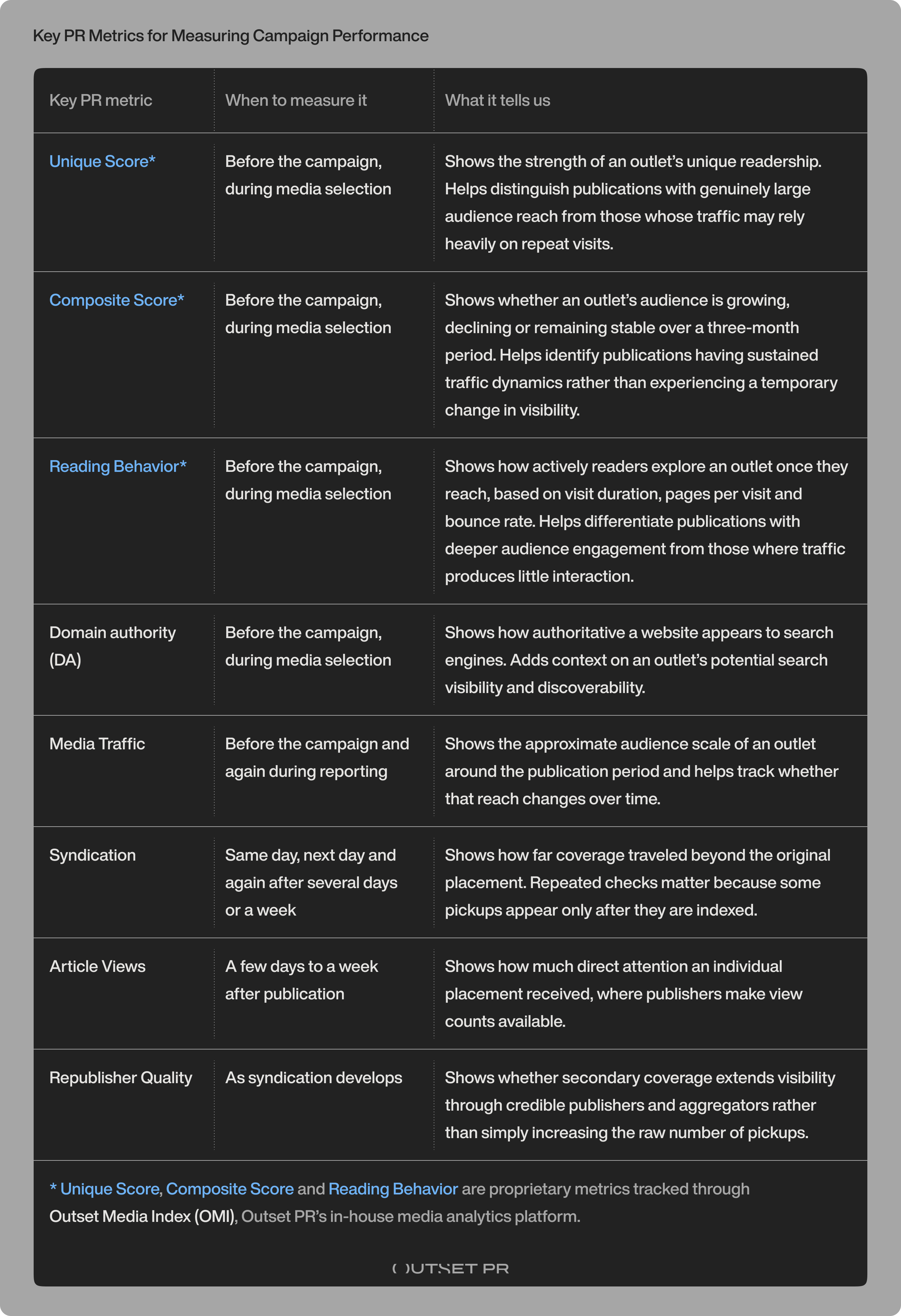
The important part is not to turn any one of these into a universal PR KPI. A high DA, for example, may reflect years of accumulated authority without indicating how much traffic the publication generates today. Likewise, a niche outlet may have a smaller audience but strong relevance within a specific market, while a newer publication may attract meaningful traffic before it has had time to build domain authority.
Which metrics matter most also depends on the campaign goal. An outlet’s age and track record can provide useful context when trust is the priority. For reach-focused campaigns, Traffic Depth Ratio, one more specialized metric we track through Outset Media Index, can help identify publications that are gaining or losing audience momentum.
That said, the useful signal usually comes from reading several indicators together and choosing the combination that matches what the campaign was intended to achieve.
Can PR ROI actually be measured? Sometimes, yes
Most PR campaigns don’t produce a clean line from publication to conversion. A user might discover a product through an influencer, encounter it again through independent coverage, search for the brand and only then sign up. Once several channels are involved, assigning the final action to any single one can distort its real contribution.
So it’s difficult to attribute but not impossible to measure. Under the right conditions, PR's impact on business outcomes can become surprisingly clear.
When ROI can be calculated directly
In one highly specialized campaign model, we found that publishing a large volume of articles in specific formats and carefully selected media outlets could push individual stories high enough in Google Discover – and, in some cases, Google Top Stories – to generate tens of thousands of views.
- What we could track: spending on placements → traffic from the articles → target actions.
- What it showed: the two normally distant points of PR, spending and resulting revenue, could be connected, making ROI calculable.
- The limitation: this was a purpose-built campaign model rather than a standard way to measure. Most media efforts don’t have such a traceable conversion path.
When indirect evidence becomes unusually strong
Before founding Outset PR, Mike Ermolaev spent roughly six months providing crypto market analysis to the Brazilian edition of Cointelegraph as ChangeNOW’s head of PR. Editorial rules prevented those articles from linking directly to the company’s website; the author profile instead linked to his X account.
- What changed: Mike's profile gained almost 800 followers, with no extra promotion involved.
- What else was found: referrals to the ChangeNOW website from Yahoo Brasil increased roughly twelvefold.
- Why it mattered: ChangeNOW was running no other dedicated media campaigns in Brazil during the period, leaving considerably fewer competing explanations for both shifts.
Sometimes the strongest evidence is not a tracking link, but several independent signals moving after a specific activity while little else around them changes.
When the campaign is more meaningful than an individual placement
Outset PR’s campaign for ChangeNOW combined coverage, traffic acquisition and thought leadership instead of asking every placement to produce a standalone conversion.
- Media output: 40+ media outlets mentioned the brand organically, alongside 600+ traffic-generating articles and 100+ expert quotes by the company’s CMO.
- Business results: organic reach increased by 40%, while total turnover grew by 20%.
- What it showed: PR can still be evaluated as part of a broader growth system without assigning individual conversions to individual articles.
The difference between these examples is how much the available data allows us to prove. Sometimes there is a trackable way to revenue. Sometimes a few separate signals leave little room for another explanation. And sometimes PR works alongside other growth channels, where its contribution is better assessed at the campaign level than by tying each result to a particular placement.
How LLMs are changing PR measurement
The same logic increasingly has to account for a new discovery layer. People now ask ChatGPT, Claude, Grok or other LLMs about a product instead of searching for it directly, comparing several articles or visiting a brand’s website first.
For PR, this adds another destination for the information we put into the market. Media coverage still needs to reach relevant audiences, perform in search and spread through aggregators and communities. But it can also shape the sources and signals that LLMs use when deciding which companies to mention, recommend or cite.
The underlying business goals haven’t fundamentally changed. What has changed is the path to them. At the moment, we can evaluate two parts of that path with very different levels of confidence:
- AI search visibility is already measurable. We can track whether a brand appears for relevant prompts, how frequently it is mentioned or recommended, where it ranks against competitors and whether that presence improves over time. This is the analytical layer behind our LLM seeding for brand discovery service: we treat AI visibility as something that can be benchmarked, monitored and deliberately improved rather than as an accidental by-product of conventional PR.
- LLM traffic is much harder to attribute. Analytics can show some referrals from AI platforms, but the journey from an answer inside an LLM to a visit, signup or purchase remains far less transparent than established digital channels. Predictably generating and attributing that traffic remains an open problem.
This gap will narrow as both AI models and analytics infrastructure mature. But it doesn’t require PR to invent an entirely new definition of effectiveness. The challenge is to understand the role LLMs now play between discovery and conversion and evaluate their contribution without claiming more than the available data can support.
From PR metrics to business outcomes
PR is not a performance ad, and forcing every campaign into the same conversion model misses much of what it can actually do. The better starting point is the business goal: define what needs to change, determine how communications can support that change, choose the metrics that reflect it, and only then decide how confidently the result can be attributed.
That is also how we build our PR strategies. Depending on the client’s growth stage and priorities, the goal may be user acquisition or sales, fundraising, brand awareness, personal brand development, go-to-market expansion, search position and LLM visibility, reputation management or crisis communications.
Data-driven PR is therefore not about claiming credit for every conversion. It is about knowing what the data proves, what it suggests, and where communications interact with other channels driving progress.
Have a growth goal but not sure where PR fits into it? Talk to the Outset PR team to build a campaign around the outcomes that matter to your business.


