
In the first four months of 2026, 68.01% of Google searches in the U.S. ended without a click, according to SparkToro research based on Similarweb clickstream data. AI Overviews now appear in more than 20% of Google searches, and when they do, click-through rates fall by nearly 60%.
We had a chance to examine what this shift means for AI visibility in practice through our work with IronWallet. As part of its LLM seeding campaign for brand discovery, we focused on strengthening the wallet’s association with specific product use cases. We then tested 17 non-branded queries across ChatGPT, Gemini, Grok, and Claude to see where IronWallet would surface without users asking for it by name.
The results showed a sharp divide: the brand was nearly absent from broad wallet queries, but appeared consistently in AI answers once the questions moved closer to specific product capabilities.
What we found:
- IronWallet was included in 46.6% of responses across the 17 relevant non-branded discovery queries we tested. Across 204 responses from four AI assistants and three locations, the wallet was identified 95 times.
- Visibility varied across platforms. Gemini returned IronWallet most often, in 58.8% of tested responses, followed by Claude at 51.0%, ChatGPT at 43.1%, and Grok at 33.3%.
- Some product associations proved much more consistent than others. “Best gasless stablecoin wallets” and “Non-custodial wallets with gasless USDT” surfaced IronWallet across all three locations in ChatGPT and Gemini, while the latter query also produced mentions across all three locations in Claude.
- Relevance alone didn’t guarantee inclusion. IronWallet appeared only once across 12 responses to “Top non-custodial crypto wallets of May 2026” and in three out of 12 responses to “No-KYC USDT wallets,” showing how differently the same product can perform across adjacent discovery intents.
Taken together, the results suggest that IronWallet’s visibility was highly dependent on query context. That distinction became central to how we approached LLM seeding for the wallet.
Methodology
To see how consistently AI assistants could connect a crypto wallet with specific user needs without being prompted with its name, we used data from an internal IronWallet AI search visibility test conducted in June-July 2026.
The test was built around 17 discovery queries covering product categories and use cases relevant to IronWallet, including gasless stablecoin transactions, non-custodial storage, no-KYC wallets, WalletConnect support, privacy, stablecoin payments, and multi-chain functionality.
Each of the 17 prompts was tested across ChatGPT, Gemini, Grok, and Claude from three locations: Germany, Serbia, and the United States. The same prompts were used in every location, producing 204 individual responses in total, or 51 observations per platform.
For each response, we recorded a binary result:
- Yes – IronWallet appeared in the answer, regardless of its position.
- No – the company wasn’t mentioned.
We then calculated each assistant’s visibility rate as the percentage of the 51 responses in which IronWallet was included.
This methodology measures brand presence in AI answers rather than ranking position or recommendation strength. The resulting visibility rate therefore shows how often IronWallet showed up across the tested queries, not how prominently or favorably it was presented.
Broad AI visibility vs. owning a specific niche
IronWallet’s overall 46.6% visibility rate masks a much wider variation at the query level. The clearest divide emerged between broad crypto wallet recommendations and prompts tied to specific functionality.
When we asked the four AI assistants for the “Top non-custodial crypto wallets of May 2026,” IronWallet returned in only one of 12 responses across the three locations tested – an 8.3% visibility rate.
But narrowing the question to a product capability changed the picture considerably.
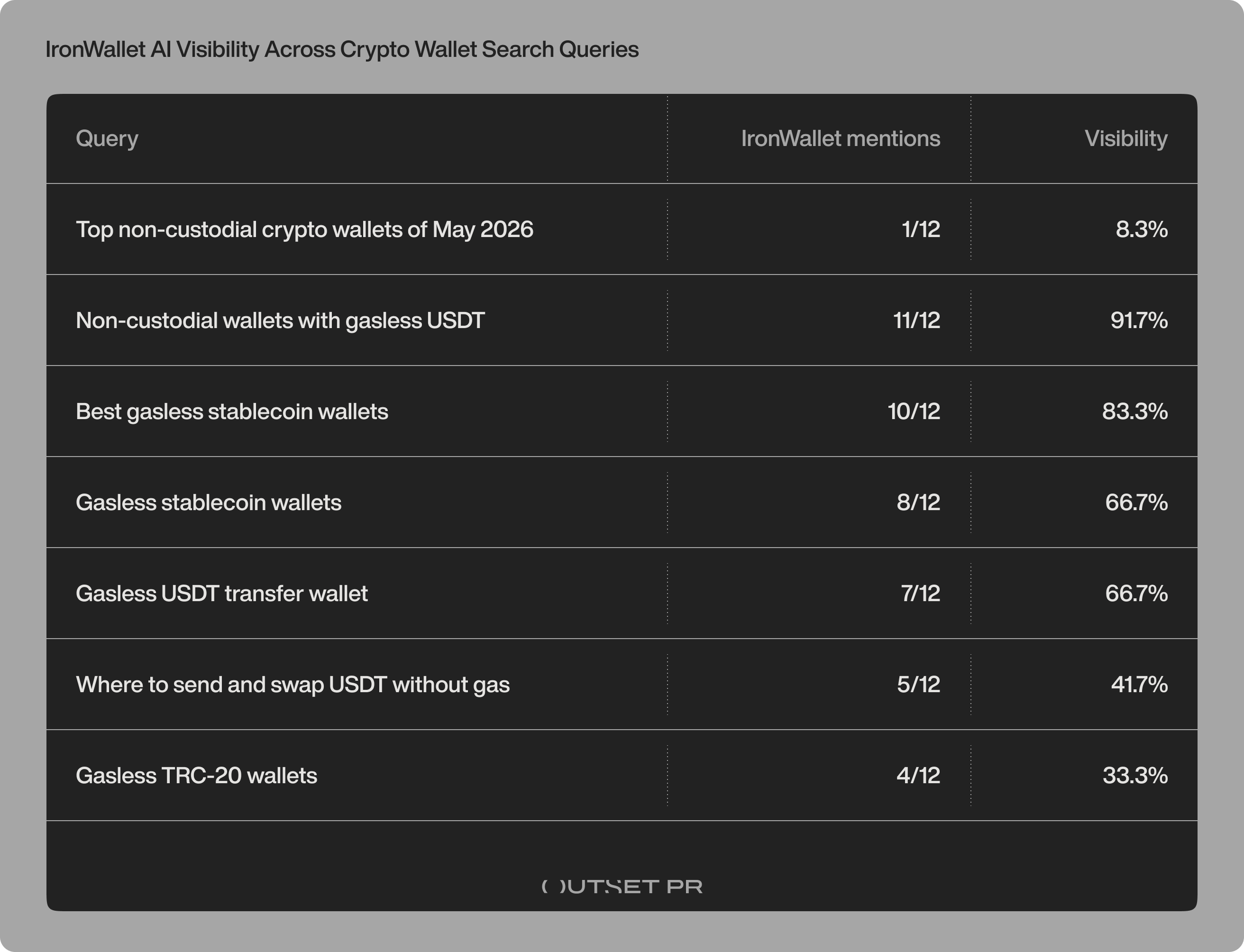
The strongest visibility clustered around gasless stablecoin use. Both of the top-performing queries explicitly combined IronWallet’s broader self-custody positioning with the functionality that distinguished it most clearly: sending stablecoins without holding native gas tokens.
The same association is visible in Google AI Overviews
The June-July 2026 test provides a snapshot of IronWallet’s visibility across four platforms. A current Google AI search offers another signal that the same product association extends beyond those original tests.
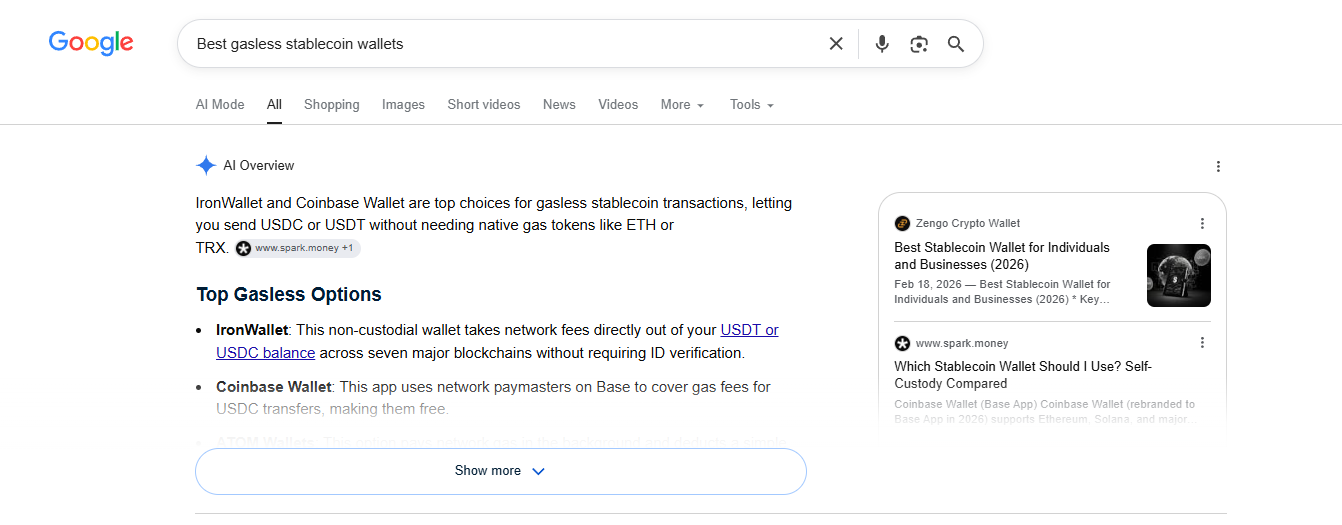
Google’s AI Overview for “Best gasless stablecoin wallets” places IronWallet first among its “Top Gasless Options,” ahead of Coinbase Wallet, specifically highlighting its ability to deduct network fees directly from a user’s USDT or USDC balance.
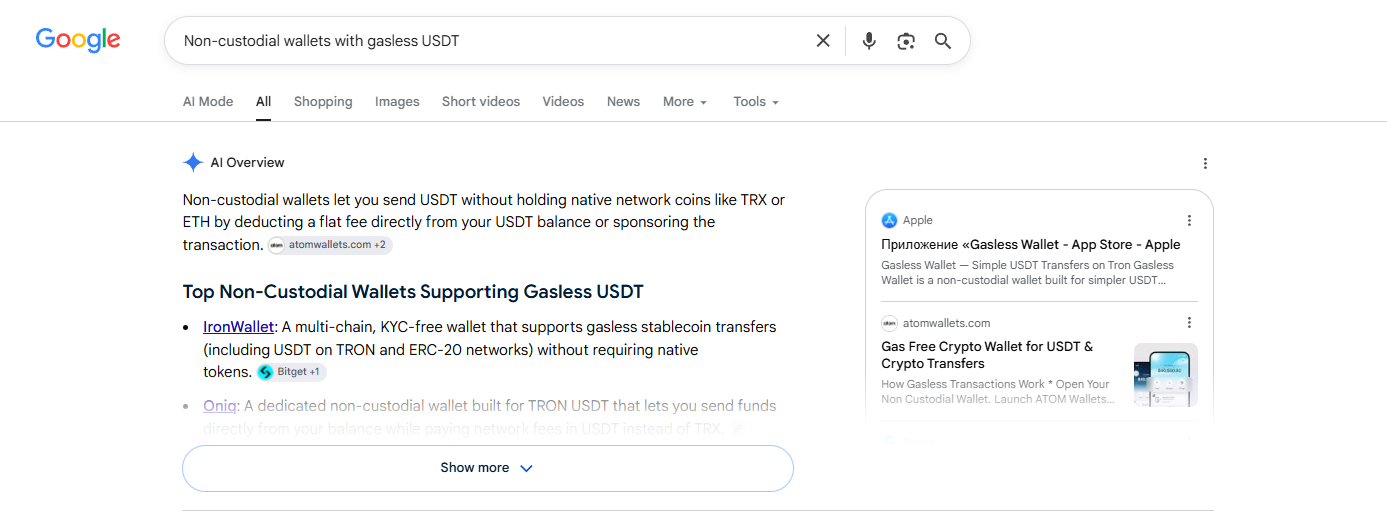
The pattern repeats for “Non-custodial wallets with gasless USDT.” Google again lists IronWallet first, this time specifically linking it with multi-chain, KYC-free gasless stablecoin transfers.
Inside IronWallet’s LLM seeding strategy for brand discovery
Rather than asking, “How do we make AI mention IronWallet more often?”, we started with the product itself: where does it have a genuine reason to be mentioned? Several strengths offered potential entry points, but one stood out as particularly distinctive: the ability to send USDT and USDC without holding a separate native token to cover gas fees.
Building the association around gasless stablecoin use
We designed the campaign to reinforce that connection across third-party editorial content. Rather than relying on a single type of coverage, we looked at the topic from different angles, combining direct coverage of gasless stablecoin functionality with adjacent contexts relevant to the wallet.
The goal was to establish a recognizable association: gasless stablecoin transfers → USDT/USDC without native gas tokens → IronWallet.
Someone asking an AI assistant how to send USDT without TRX may have never heard of IronWallet. This overlaps with what is often described as generative engine optimization (GEO), but our LLM seeding approaches the problem from a positioning perspective: which questions should the company have a credible reason to appear for in the first place?
A reality check: this service is not a shortcut to the “best of the best”. LLM seeding for brand discovery is cumulative work, not a way to manufacture category leadership overnight. For a smaller player, the realistic opportunity is to earn a place alongside established names where its actual strengths make it particularly relevant to the question being asked.
AI visibility starts with having a reason to be mentioned
AI visibility is increasingly becoming a positioning problem, not just a search ranking problem. Being mentioned more often is not enough. LLMs need credible external context to understand what a company offers, where it fits, and which user needs it can genuinely address.
As AI search and discovery become a larger part of how people research and compare products, the question is no longer only “Can people find us?” It is also “Does AI know when to mention us?”
If you have a reason to be part of the answer, we can help make that connection clear.


