
Together with Outset PR founder and CEO Mike Ermolaev and head of security and compliance Alice Frei, we looked at how Web3 and crypto crisis communications should change across scenarios, from deciding whether to react at all to choosing the right spokesperson, media strategy and escalation path.
A crisis plan starts before something goes wrong
Crisis communication works better when the first decisions are made before anything actually happens. In practice, identifying five to seven major threats is often enough to cover probable directions a situation could take.
For an established company, the most likely scenarios are visible from the start: internal failures, customer accusations, technical incidents, regulatory changes or problems involving key decision-makers.
The goal of a crisis communication strategy is not to script a response to every possible risk. Similar issues can vary significantly in scale, visibility and potential impact. A complaint that receives ten reactions on a forum calls for a different approach when it comes from a creator with 1.5 million followers.
So a crisis response plan should first define a set of triggers that helps determine the scale of the threat and the appropriate course of action. These can include the source of the story, its reach and speed of spread, whether users or assets are affected, and the potential legal exposure.
Once those thresholds are defined, the team can choose between four basic scenarios:
- Stay silent: monitor the situation without giving a limited or fading story additional attention. This makes sense when the issue is not escalating and there’s no operational or legal reason to respond.
- Respond privately: communicate directly with affected users or stakeholders when they need practical information or reassurance, but the issue doesn’t require a broader public statement.
- Respond publicly: use the company’s own channels to establish its position, provide verified facts or share a broader update. This is critical when the issue is already visible, public clarification is needed or silence risks leaving an information vacuum.
- Communicate through third parties: work with journalists or other credible external voices when the brand needs its position to reach a larger audience or enter an existing public discussion without relying solely on its own channels. Bringing in an external perspective also helps when the people making the decision are directly involved in the situation and under pressure to respond quickly.
If an unexpected situation falls outside this framework, the priority is still to decide on the strategy before publishing anything. Once a company speaks publicly, that statement becomes part of everything that follows and can limit its room to maneuver.
Crisis communication strategies for four common scenarios
Once the crisis management framework is in place, the next question is what kind of situation the company is actually dealing with. All can threaten reputation, but the immediate goal varies by case.
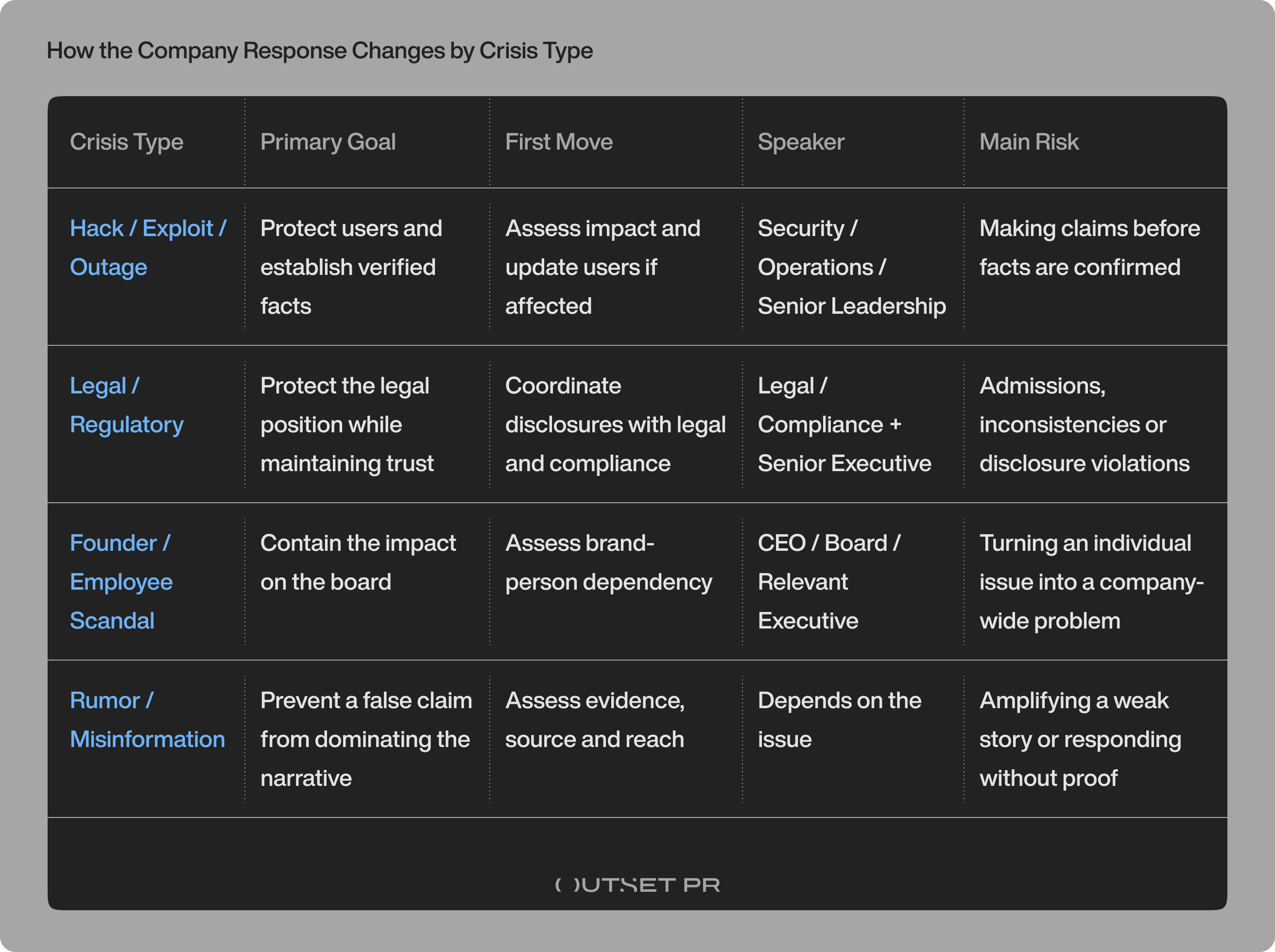
Hack, exploit or outage. A small issue fixed before people notice may require no comment while a user-facing outage calls for an operational update and a credible ETA where possible. An exploit needs security and compliance involvement, especially if notification obligations apply. Claims such as “all funds are safe” should wait until the facts are verified.
Legal or regulatory action. A public statement can itself create additional exposure, so communications and counsel have to work simultaneously. Public messaging should distinguish facts from allegations, meet disclosure requirements and remain consistent with what the company tells regulators, investors or courts.
Scandal involving a founder or employee. From a reputation management perspective, the key question is whether the individual can be separated from the brand. Apple is much less dependent on Tim Cook’s public persona than Tesla has historically been on Elon Musk’s. The stronger that connection, the more likely personal conduct is to affect perceptions of the company itself.
Rumor or misinformation. When responding to misinformation, evidence is stronger than a simple denial. But not every accusation deserves a response: when proof is limited or a story has little reach, rebutting it can amplify it instead. Recurring allegations are more dangerous because they can gradually become associated with the brand.
Media strategy should match the scale of the crisis
Choosing where to respond is as important as deciding what to say. In practice, media strategy comes down to three decisions: which channels to use, how wide the response needs to travel and which journalists should carry it further.
1. Choose the channel:
- Owned channels establish the official position, provide operational updates and give affected users direct instructions.
- External channels bring that position into the wider conversation, add third-party context and reach audiences beyond the company’s existing ecosystem.
Not every situation requires both. A limited issue can be handled through an owned update or targeted media outreach, while a developing situation may require a combination of channels as attention grows.
2. Match media reach to the scale of attention. The wider the issue spreads, the further the response needs to travel:
- A tier-1 publication can extend a company’s position through follow-up coverage and syndication.
- A larger number of tier-2 placements can serve a different purpose when search visibility and greater narrative presence matter.
3. Match the journalist to the story:
- For a major development, subject-matter specialists are often the priority, as they already understand the issue and have the audience most likely to follow it.
- For a smaller company or a situation with limited news value, established journalist relationships will provide a more realistic route into the conversation.
From crisis response to reputation recovery
Reputation recovery planning should start while the immediate response is still underway. While one part of the team handles statements, user updates and incoming media requests, another can already assess what may happen next and what will be needed once the situation stabilizes.
The key indicator is control. During escalation, a brand usually has less room to shape the information environment: new details emerge, coverage expands and outside parties drive the conversation. As that momentum slows, it gradually regains the ability to introduce its own context, stories and priorities.
That doesn’t mean launching a positive counter-narrative at the first sign of improvement. Moving too early can look disconnected from what users, journalists or other stakeholders are dealing with.
The transition from reactive to proactive communication should begin when escalation is slowing and there is enough control to start shaping the agenda without ignoring the original problem.
Signs the strategy is working:
- fewer new negative stories are appearing;
- discussion intensity is declining;
- the story is losing momentum;
- fewer new allegations or extensions of the original narrative emerge.
Still, these signals measure whether the environment is stabilizing, not whether every consequence has disappeared. Public silence doesn’t necessarily mean the situation is resolved. Media attention may fade while legal, regulatory or law-enforcement processes continue.
The best Web3 crisis communication plan is a system of triggers, escalation rules and decision paths that tells a company when to speak, who should speak and how wide the response needs to go.
Need to build or stress-test a crisis communication plan in advance? Talk to the Outset PR team.


