
Important note: As ODP has undergone a rebrand and become the research arm of Outset Media Index, all reports now live in OMI’s content hub. We’ll be periodically summarizing the strongest findings on this blog, with enough context to show why they matter, and links to the full versions for those who want to explore the data in depth.
Signal #1: Prediction markets could become a new media revenue stream – but architecture decides who gets paid
Publisher economics are deteriorating. Since 2023, referral traffic to news has fallen 46% from Google Search, 67% from Facebook, and around 50% from X. Subscription growth has flattened outside the largest news brands. What the industry needs is not another advertising format, but a revenue category large enough to affect the P&L.
Prediction markets may be one. Industry trading volume is projected to reach $200–240 billion in 2026. But simply embedding a prediction market doesn’t guarantee the media company gets paid. The architecture is the real decisive factor.
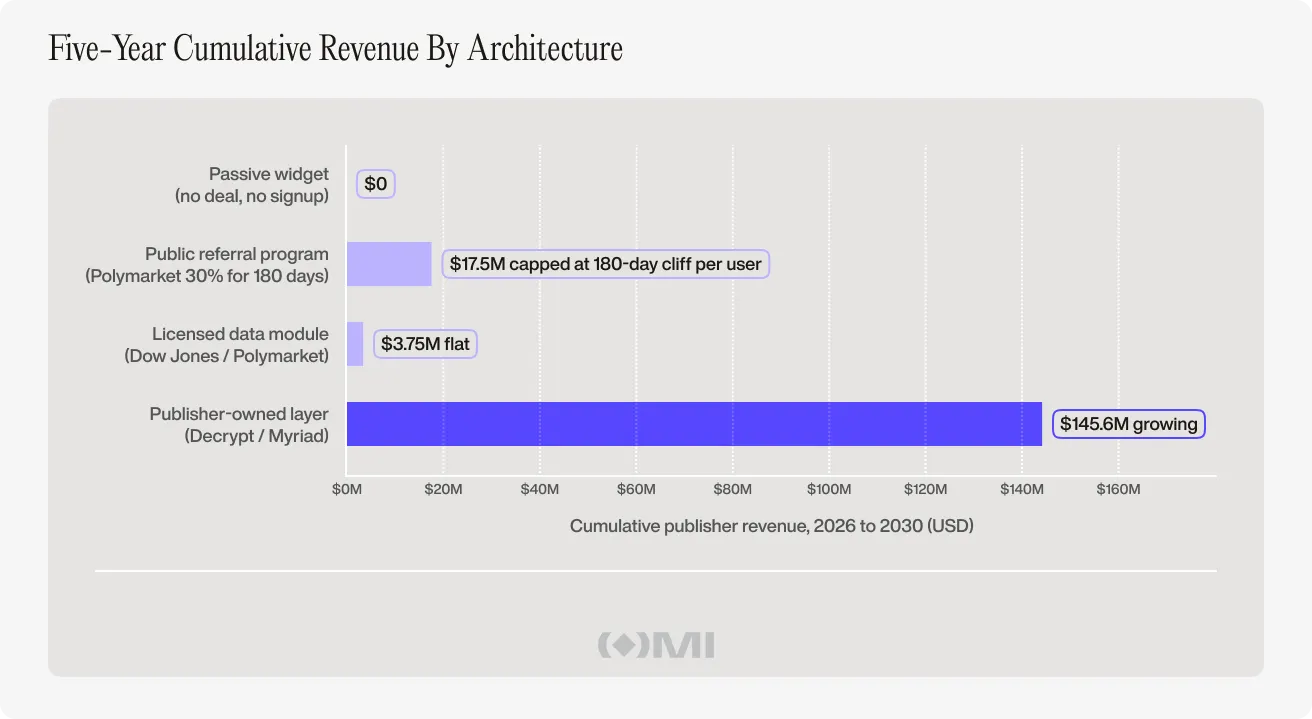
A passive widget sends readers to an external platform and returns nothing to the host site. A partner program pays a temporary share of fees while a licensed data module pays fixed annual fee. If an outlet provides the context but sends the resulting action elsewhere, it surrenders the most valuable part of the chain. It is the classifieds mistake again: newsrooms built the audience; external platforms reaped the rewards.
A publisher-owned layer changes that inequity. It keeps the trade on the outlet’s surface and captures the full platform fee. Over five years, that owned model can generate roughly eight times more income from the same audience than Polymarket’s public referral program. Much of the gap comes from the program’s 180-day cliff: the media partner earns from a trader it brings in for six months, while every later trade benefits Polymarket alone.
Read the full report for the math behind the 180-day cliff, outlet-level income models, and the top-down and bottom-up projections for prediction markets as a publisher revenue category through 2030.
Signal #2: More publishing doesn’t mean more attention per article
AI is making content creation faster and cheaper, but the time readers can give it remains limited. So what happens when newsrooms add stories faster than their audience grows?
To compare media brands with very different content schedules, OMI analysts introduced a directional proxy: traffic-adjusted visits per article per day, calculated from monthly traffic and the estimated number of stories released daily. It isn’t actual pageview data for individual pieces, but an indication of how thinly each site’s audience may be spread.
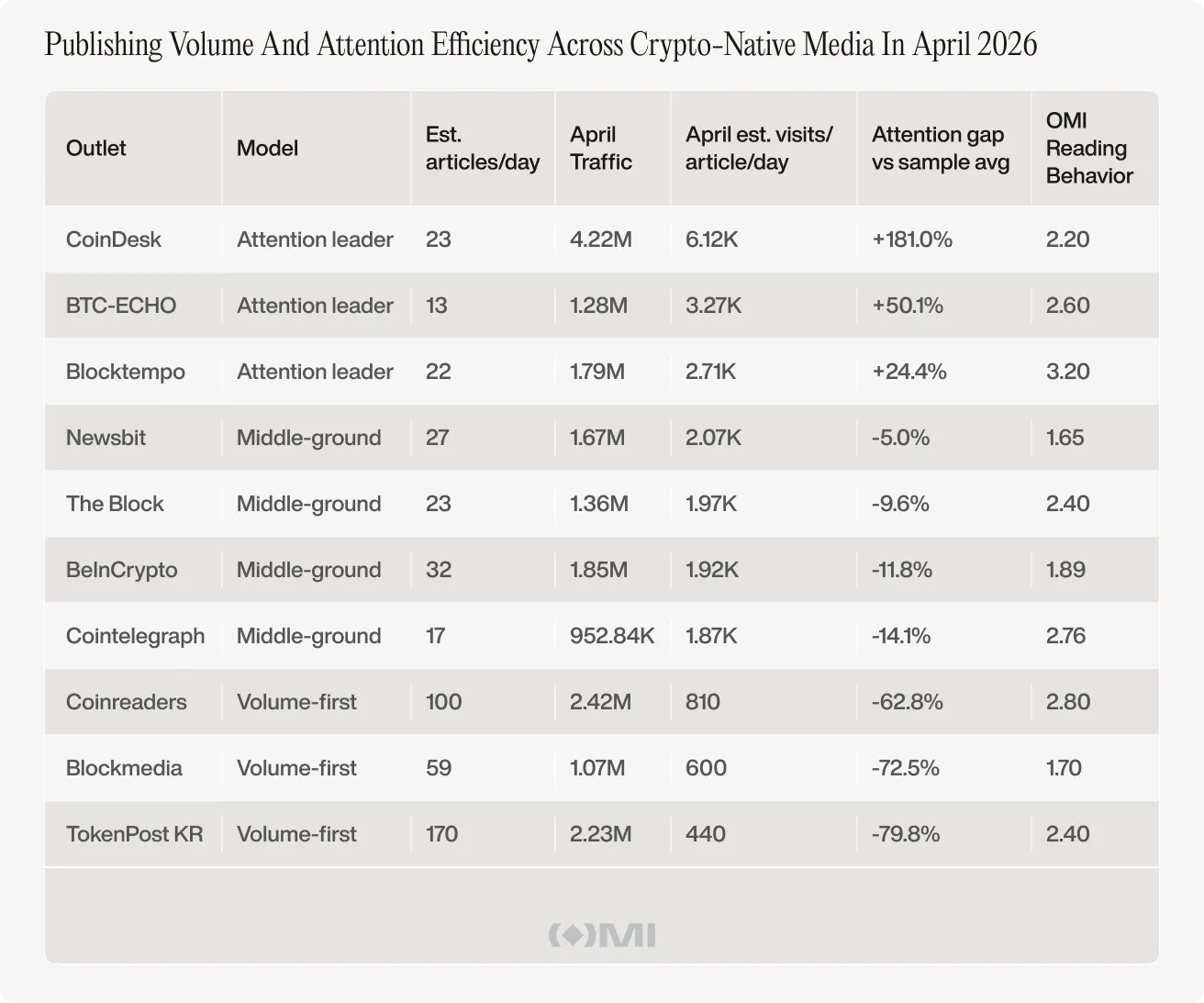
Across the ten crypto-native sites in the sample, the leading group averaged 19.3 stories a day and about 4K adjusted visits per piece. The volume-first group increased that pace to 109.7, but averaged only around 600 adjusted visits per item. CoinDesk produced the strongest result: 6.12K adjusted visits per story, 181% above the sample average, without relying on extreme volume.
High-output outlets can still serve breaking news, regional coverage, aggregation, and search visibility, but a heavier editorial schedule doesn’t deliver proportionately more exposure per story. For PR teams, monthly traffic is therefore incomplete on its own. A placement’s potential value also depends on how much other content is competing for the same audience.
Read the full report for the more detailed model-by-model comparison, the TokenPost KR case study, and the methodology used to estimate publishing frequency and attention efficiency.
Signal #3: AI only improves newsroom economics when humans stay in the loop
Within a newsroom, generating content with AI costs almost nothing, and the operating math seems to favour a machine-only model. While a human-written crypto story costs roughly $14-26, such a pipeline can bring that figure down to about $2. But those savings come with the highest risk of ranking collapse and reputational damage.
In a 16-month experiment by Search Engine Land, the share of unedited machine-written pages holding a top-100 ranking fell from 28% to 3%. Separately, 52% of readers disengage once they suspect content is AI-generated.
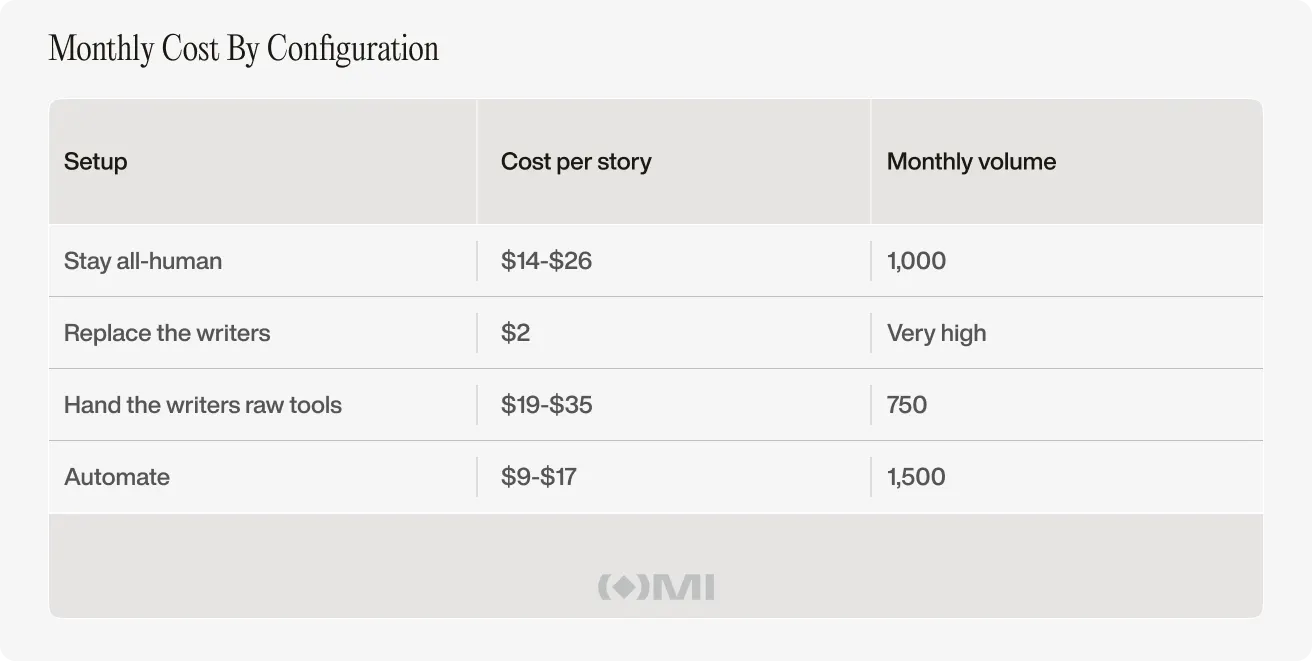
An automated workflow with human review offers a stronger trade-off: the per-story expense falls to approximately $9-17, while modeled monthly output rises from 1,000 to 1,500 pieces. AI handles research, initial structuring, formatting, and repetitive tasks. Writers and editors maintain control over facts, tone, framing, and the final decision to publish.
Here, the structure is what prevents economics from settling into an expensive middle ground. Giving writers chatbot subscriptions without redesigning the process itself can add prompting, rewriting, and verification work, leaving the newsroom less productive despite paying almost nothing for the tools.
Read the full report for the complete model breakdown, real-world examples of failed AI publishing, and a visualized map of LLM cost vs creative writing quality.
Conclusion: Crypto media should scale control, not just output
Prediction markets create a new revenue layer, but only if media companies retain the economic benefits generated by their audience. A heavier content schedule can leave less attention for each individual story. AI improves unit economics only when automation supports rather than removes editorial control.
The strongest outlets will not necessarily be those with the most traffic, the highest output, or the lowest generation costs. They will be the ones that capture more value from each reader, make every story matter, and raise efficiency while keeping their editorial product distinctive.
Subscribe to Outset Media Index on Substack to get the full datasets, charts, and methodology behind each report delivered straight to your inbox – and to catch the next signals worth questioning for your media strategy.


