
The idea that news drives crypto prices has been around as long as the industry itself. And it was hard to argue otherwise: a single headline could “trigger” a breakout or a panic sell-off within hours.
Now that relationship has changed.
Crypto doesn’t react to news in the same direct way it once did. And more importantly, it’s worth asking whether headlines were ever as predictive as we assumed.
Why headlines used to move the market so violently
The “old” market had very little distance between information and price. Liquidity was thinner, spot trading played a larger role in price discovery, and crypto market sentiment moved faster and more visibly.
That made responses to news coverage much more explosive than today. When risk sentiment shifted, it showed up quickly on the chart: traders reacted in the open, volatility came shortly after, and major headlines could turn into immediate price action within hours.
When Tesla disclosed its Bitcoin (BTC) purchase in early 2021, the OG coin jumped more than 15% within hours – from around $38,000 to above $44,000 in a single session. A few months later, China's crackdown on BTC mining sent it from roughly $40,000 to near $30,000 in a matter of days. Panic selling, forced liquidations, cascading declines. The price just collapsed.
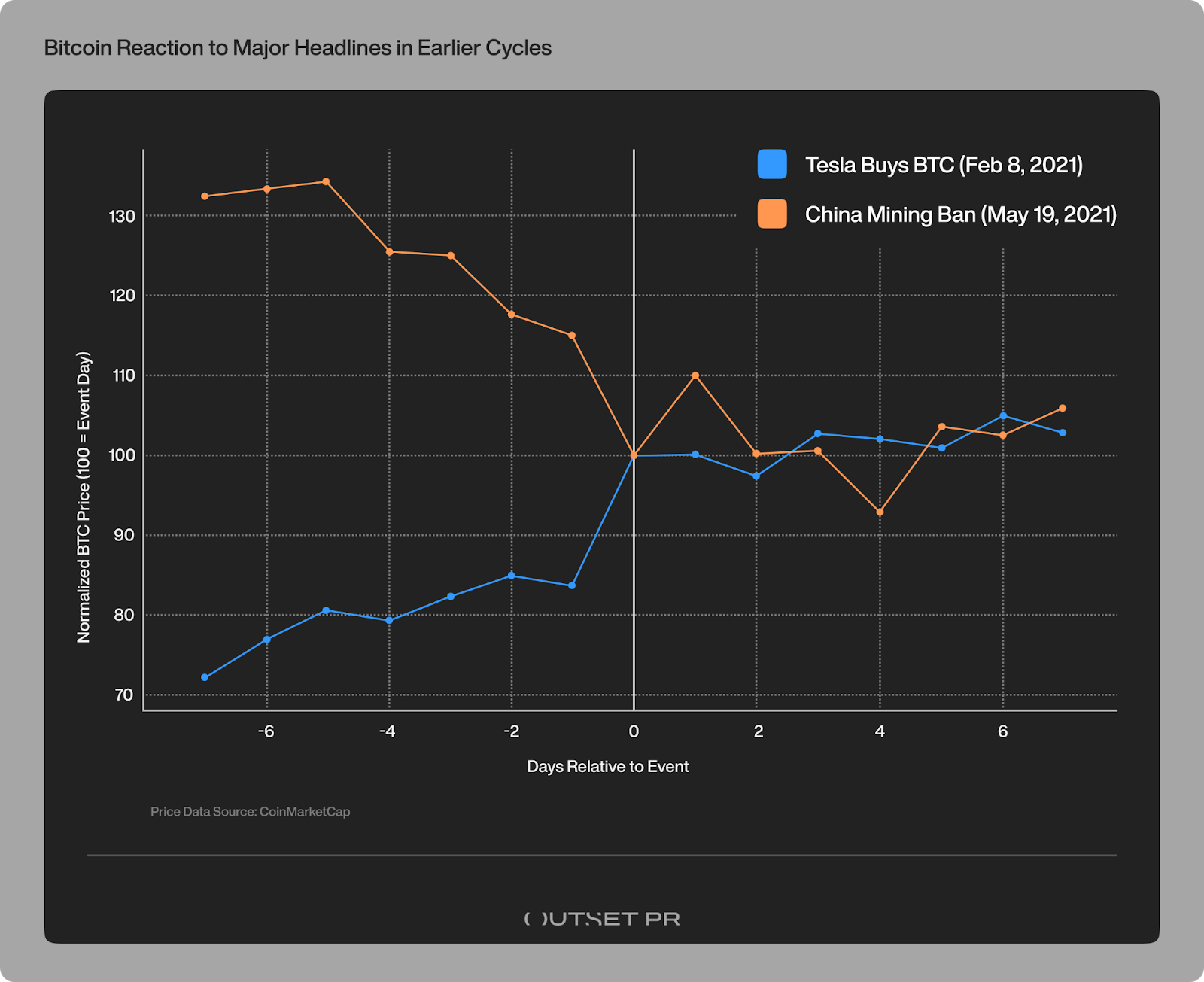
It’s not like the news itself back then was stronger. The market around it was simply shallower, more emotional, and less buffered than it is today.
What changed in the crypto market in 2025-2026
It would be strange to expect the same reaction pattern from a market with a more mature structure.
First, it’s derivatives. A large share of repositioning now happens through futures and options. That makes the reaction less visible and less concentrated on the chart. Shock gets absorbed, distributed, and delayed instead of turning straight into one sharp move.
Another shift is access. Spot Bitcoin ETFs created new channels for gaining exposure, which means news can show up through fund flows rather than through an immediate spot candle. Add execution via OTC desks and institutional investors, and the picture becomes even quieter: large players can adjust positions without forcing an obvious price reaction in real time.
BTC in general is increasingly treated as a macro asset, shaped by liquidity conditions, risk appetite, and policy expectations. 2025 made that especially clear: major political news fed into a broader environment of uncertainty that changed how investors positioned overall. So, do headlines move Bitcoin now? They do, usually through the macro backdrop they reinforce.
The market became deeper, more layered, and harder to read through spot price alone.
We say prices no longer react to news headlines the way they used to – but did they ever?
Here comes the most interesting part. The data suggests the headline-driven model may have been overstated from the start.
The recent Outset Data Pulse report shows that, across 63,926 CoinDesk headlines matched against 12 years of Bitcoin price data, daily news volume had no predictive power for what the coin did next. If anything, the sequence more often ran the other way: price moved first, and coverage followed.
That means the industry tends to price expectations earlier. By the time a development becomes official, part of the move may already be behind it. For instance, Gary Gensler’s departure as SEC Chair pushed BTC higher gradually, with much of the action happening before the change was formally confirmed.
The same pattern held on the other major news days. Bitcoin was often already elevated before the coverage spike, then drifted lower afterward. Even the January 2024 spot ETF approval, one of the biggest headlines in crypto, didn’t produce the kind of clean follow-through.

Again, that doesn’t mean Bitcoin never reacts to news. A daily study can miss brief intraday moves or slower narrative shifts building over weeks. But it does sharpen the point: loud headlines alone are not a decisive factor, and tighter market liquidity only makes that easier to see.
Price and coverage may move in parallel, yet parallel timing is not the same as causation.
Why this matters for crypto brands, PR teams, and market observers
If that’s how price and news actually interact, the implications go beyond trading.
If coverage can’t guarantee an immediate move in crypto markets, then its value can’t be measured by price action alone. A story may leave no visible candle and still shape expectations, strengthen narrative familiarity, support legitimacy, or influence how investors interpret what comes next.
For brands, this means coverage shouldn’t be treated as a one-shot trigger. What matters is whether visibility in crypto media is building recognition around the project, placing it inside credible discussions, and creating a stronger frame for interpreting future events such as partnerships, listings, fundraises, or regulatory developments.
For PR teams, the question “Did this story move the market?” is too narrow. The more useful one is whether the coverage strengthened the narrative environment around the project.
Coverage still matters – but through a different mechanism
The old model – headline, instant move, obvious reaction – doesn’t explain crypto very well.
Today, the reaction is more distributed. Part of it is anticipatory, part of it moves through positioning and liquidity, and part of it only becomes visible once broader expectations start to shift. That makes the effect of coverage harder to read in real time, but not less real.
That is also why “buy the rumor, sell the news” in crypto no longer works as a universal rule.


