
Cointelegraph – founded in 2013 – is one of the longest-operating crypto-native news outlets. Over more than a decade, it covered every major cycle of the industry, from the early Bitcoin crashes and the 2017 ICO boom to DeFi summer, the 2021 bull market, and the collapse of FTX. It expanded into multiple regional editions and became a structural fixture in crypto news discovery, frequently ranking at the top of major search queries and cited by both crypto-native and traditional financial outlets.
Last year, its traffic peaked at 8.08M visits in July, then began contracting sharply. According to Similarweb data, Cointelegraph’s U.S. visits had fallen to 1.43M by the year end, a total decline of 6.65M over five months, averaging 1.33M fewer visits per month. Overall, the publication’s U.S. traffic contracted by 82.27% from July to December, and 71.27% in Q4 alone.
In an industry accustomed to volatility, this was not a routine dip. Google had just completed a major Spam Update. Other crypto outlets also experienced ranking turbulence – some declined, others surged.
This article examines the data and technical signals surrounding Cointelegraph’s decline and the broader context of Google’s evolving spam enforcement. The goal is to understand how algorithmic authority is shifting – and what that means for crypto media operating in a YMYL-sensitive environment.
If a flagship brand can lose most of its search visibility within a single update cycle, the implications extend far beyond one publisher but to the structure of information discovery itself.
Cointelegraph fell nearly three times faster than the U.S. crypto media market
Between September and December 2025 – during the Spam Update propagation window – total U.S. crypto media traffic fell from 44.38M to 29.37M visits, a contraction of 33.82%. However, that aggregate figure includes Cointelegraph itself.
To assess sector performance independently, we excluded Cointelegraph’s U.S. traffic from these totals. Once removed, the broader U.S. crypto media market declined from 38.35M visits in September to 27.94M in December, a contraction of 27.15%.

Cointelegraph’s decline, by contrast, was dramatically steeper. Over the same period, its U.S. edition fell from 6.03M visits in September to 1.43M in December, a drop of 76.24%.
Key takeaway: While the broader U.S. crypto media market fell by 27.15%, Cointelegraph declined by 76.24% – nearly three times deeper than the sector contraction.
In other words, Cointelegraph declined at nearly 2.81x the rate of its peers. This divergence is too large to attribute solely to sector-wide demand shifts. And the anomaly did not stop at Cointelegraph’s U.S. market.
The decline was synchronized across every edition
Different language markets operate under distinct audience behaviors, regulatory climates, and competitive environments. Organic volatility rarely synchronizes perfectly across geographies.
When we indexed traffic across Cointelegraph’s major international editions – using July 2025 as the baseline peak, we found that the decline was synchronized.

By January 2026:
- The English edition declined by 83% from its July peak.
- The Spanish version declined by 84%.
- The Japanese edition declined by 79%.
- The Brazilian version declined by 91%.
- The German edition declined by 75%.
Despite significant differences in audience size and regional market conditions, the shape of the collapse was nearly identical across editions. Traffic peaked in July. Then the decline accelerated in September. By October, the slope steepened and, in November, a visible cliff appeared across nearly every language version.
This is not how demand cycles behave.
Key takeaway: When multiple language editions, operating under different editorial teams and regional dynamics, collapse in parallel, the signal points upstream – toward algorithmic authority recalibration rather than localized performance issues.
Cointelegraph was less organic-dependent than the market – yet fell harder
A weighted analysis of U.S. crypto media traffic composition in Q4 2025 provides important context for understanding Cointelegraph’s collapse.
Across the entire U.S. market – including Cointelegraph – total Q4 traffic reached 106.64M visits. The weighted distribution of traffic sources was as follows: 44.06% direct, 39.71% organic search, 7.06% referral, 8.54% social, and 0.21% paid.
Excluding Cointelegraph’s traffic, the overall structure shifts only modestly. The remaining U.S. market – representing 98.14M visits – derived 42.89% of traffic from direct visits and 40.74% from organic search, with referral and social traffic accounting for 7.11% and 8.57%, respectively.
Cointelegraph’s own distribution looked materially different.
In Q4 2025, 57.52% of the outlet’s U.S. traffic came from direct visits, significantly higher than the 42.89% market baseline excluding it. Organic search accounted for 27.70%, well below the broader market’s 40.74%. Referral traffic represented 6.42%, social traffic 8.15%, and paid traffic was negligible at 0%.
This comparison is critical. Cointelegraph was not more organic-dependent than its peers. In fact, it relied less on organic search than the weighted U.S. market average. At the same time, it demonstrated materially stronger brand insulation, with direct traffic exceeding the market baseline by nearly 15 percentage points.
If the collapse were driven purely by structural overexposure to search, the outlets most reliant on organic discovery would be expected to suffer more severely. The data does not support that pattern. Instead, it suggests a performance-level recalibration within the same discovery ecosystem – one that disproportionately affected Cointelegraph despite its stronger direct traffic base.
Key takeaway: Cointelegraph relied less on organic search than the market average (27.70% vs 40.74%), and had stronger direct traffic – yet suffered the steepest decline.
Within that search exposure lies an additional nuance. Of Cointelegraph’s organic traffic, 82% was non-branded, while only 18% was branded search. This indicates that although its overall organic share was lower than the market average, its search visibility depended heavily on algorithmically ranked generic queries rather than navigational brand searches. When those rankings shift, traffic losses can accelerate rapidly even if brand demand remains stable.
The composition data, taken together, does not point to audience abandonment or structural fragility. It points to a targeted visibility contraction within the broader search ecosystem.
Key takeaway: 82% of Cointelegraph’s organic traffic was non-branded – meaning its visibility depended heavily on generic rankings vulnerable to algorithmic repricing.
Search performance is not determined by content alone. Sitemap architecture, crawl permissions, URL segmentation, and indexable commercial directories all influence how Google interprets authority and intent.
To understand whether the recalibration extended beyond rankings into domain-level configuration, we reviewed archived technical records of the site.
Structural changes visible in archived records
We compared archived snapshots of Cointelegraph’s sitemap and robots.txt files from early August 2025 with the site’s current configuration.
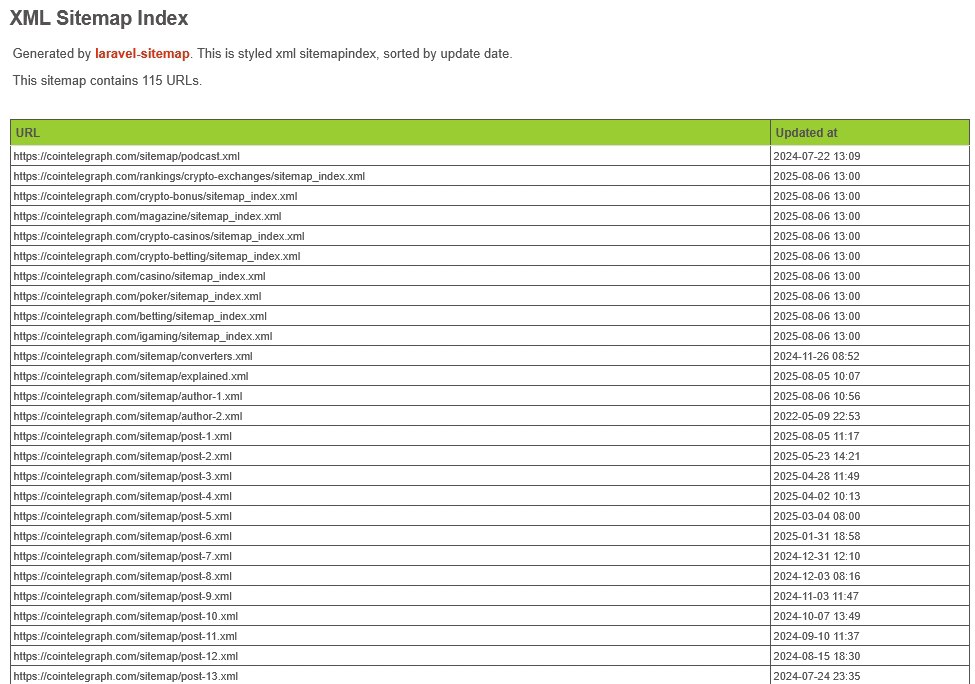
In the early August version, the sitemap index contained 115 entries. Among them were dedicated sections for exchange rankings, crypto bonuses, betting and casino content, poker, and broader iGaming categories. Each category was structured as its own dedicated sitemap entry, meaning they were actively structured for search engine discovery.
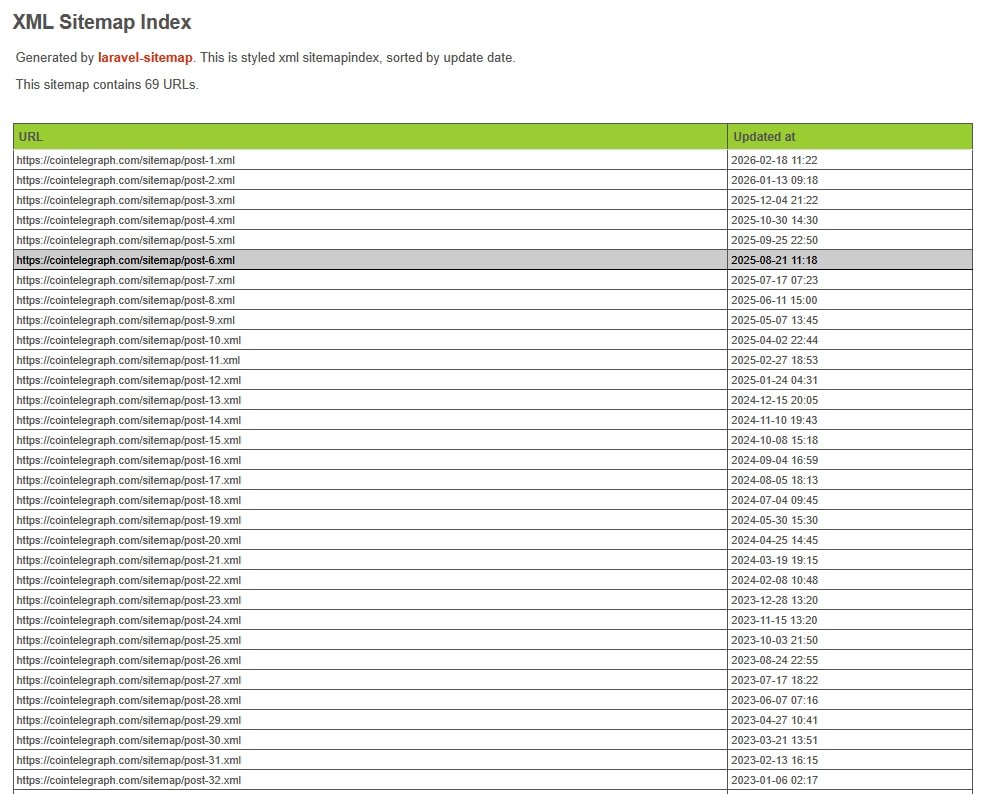
In the current version, the sitemap index contains 69 entries. The previously listed commercial directories – including rankings, bonuses, betting, and casino-related sections – no longer appear in the sitemap structure.
We also compared an archived version of Cointelegraph’s robots.txt file from early August 2025 with the current live version of the file on Cointelegraph.com. While earlier versions allowed broader crawling of commercial sections, the current configuration introduces additional restrictions. It now includes rules limiting crawler access to parts of the sponsored content directory and certain parameterized bonus-related URLs.
In simple terms, the site reduced the number of indexed commercial subsections and tightened how searсh engines interact with those areas.
Key takeaway: The domain’s commercial footprint was reduced and crawl access tightened during the visibility decline window.
.png)
These observations confirm that structural changes were made between early August and the present configuration. Commercial sections that were previously indexed are no longer included in the sitemap, and crawl access to certain sponsored and bonus-related paths has been restricted.
What this does not prove is causation. There is no public statement from Cointelegraph linking these changes to a specific Google action. However, the adjustments occurred during a period when the site’s organic visibility was declining. At minimum, the evidence shows a measurable technical recalibration at the domain level.
Conclusion: When authority is rewritten overnight
Cointelegraph’s collapse was not a routine market contraction, nor a simple case of overreliance on organic traffic. The pattern points to recalibration rather than randomness. Yet the most consequential variable remains opaque.
Publishers are left to interpret traffic cliffs through indirect evidence – traffic curves, crawl behavior, sitemap changes, and update timelines – without ever seeing the underlying scorecard.
That opacity defines the modern discovery environment. When search authority can be repriced in a single update cycle, and the criteria remain undisclosed, the industry is navigating a black box.
And if even legacy brands cannot clearly diagnose what changed, the real risk may not be traffic loss – but informational asymmetry between platforms and publishers.


