
This report follows our Q2 research on Asia’s fragmented information landscape and the in-depth analysis of local influence ecosystems, examining how traffic patterns shifted across the same markets from August to October 2025.
Key takeaways | TL;DR
- Traffic fell 14.51% from August to October, which shows fewer casual readers entered the funnel. Market interest cooled, so visibility now depends more on existing audiences than on new discovery.
- Tier-1 outlets captured about 81% of visits in August–October, essentially unchanged versus Q2’s 82% share. Even as total visits dropped, reader habits remained rigid. Rather than seeking new information sources, the remaining traffic stayed locked within the same established market leaders, such as Coinreaders, Coinpan, Blockmedia, and others.
- Direct traffic accounted for 54.38%, indicating that users actively selected destinations rather than arriving via algorithms. Brand recognition and habitual reading mattered more than search or social exposure during the slowdown.
- AI referrals reached 11.49%, making AI-driven discovery an important traffic source. Content structure now directly affects visibility, requiring publishers and PR teams to treat AI systems as a distribution layer.
Methodology: what was measured and why
We analyzed Similarweb traffic data for 120 crypto-native outlets across East and Southeast Asia over August–October. Coverage focused on media serving South Korea, Japan, China, Hong Kong, Vietnam, Taiwan, Indonesia, Thailand, the Philippines, Malaysia, and Singapore.
To ensure comparability, we excluded 39 outlets that recorded fewer than 30K visits across the three-month period, equivalent to under 10K monthly visits on average. The final sample includes 81 outlets that met the activity threshold and showed consistent audience presence during the period.
Note: External estimates can differ from a publisher’s own analytics (e.g., GA4, Adobe, Chartbeat). Reasons include modeled vs. first-party tagging, bot/IVT filtering, cookie consent/ad block, session rules/time zones, AMP/subdomain handling, private-share classification (e.g., WhatsApp often shows as “Direct”), and web vs. app coverage. We keep the methodology consistent across outlets and focus on directional trends. When material gaps appear, we note them qualitatively rather than retrofitting figures to individual dashboards.
The analysis focuses on August–October 2025, examining changes in visibility, engagement, and audience distribution across crypto-native media. Where relevant, we reference Q2 2025 only to establish baseline context. To combine growth and engagement fairly, we continue to use our Refined Composite Score (RCS), a weighted index designed to balance scale and engagement.
Speculative narrative collapse leaves only high-conviction readers
Markets do not move in straight lines, and neither does attention. After a resilient first half of 2025, Asia’s crypto media ecosystem faced a sharp contraction between August and October, mirroring the broader stagnation in digital asset prices.
Aggregate visits fell from 39.14M in August to 32.58M in September, a 16.76% decline that erased much of the early-year momentum. October offered a mild reprieve, with traffic ticking up 2.70% to 33.46M, yet the overall trend points to a market shedding its casual observers.
Counterintuitively, total visits for the period climbed to 105.18M, a 3.02% increase over Q2. The three-month reading, though positive, relies entirely on an outlier surge in August, which was likely driven by Bitcoin’s new all-time high and masked the subsequent structural decline.
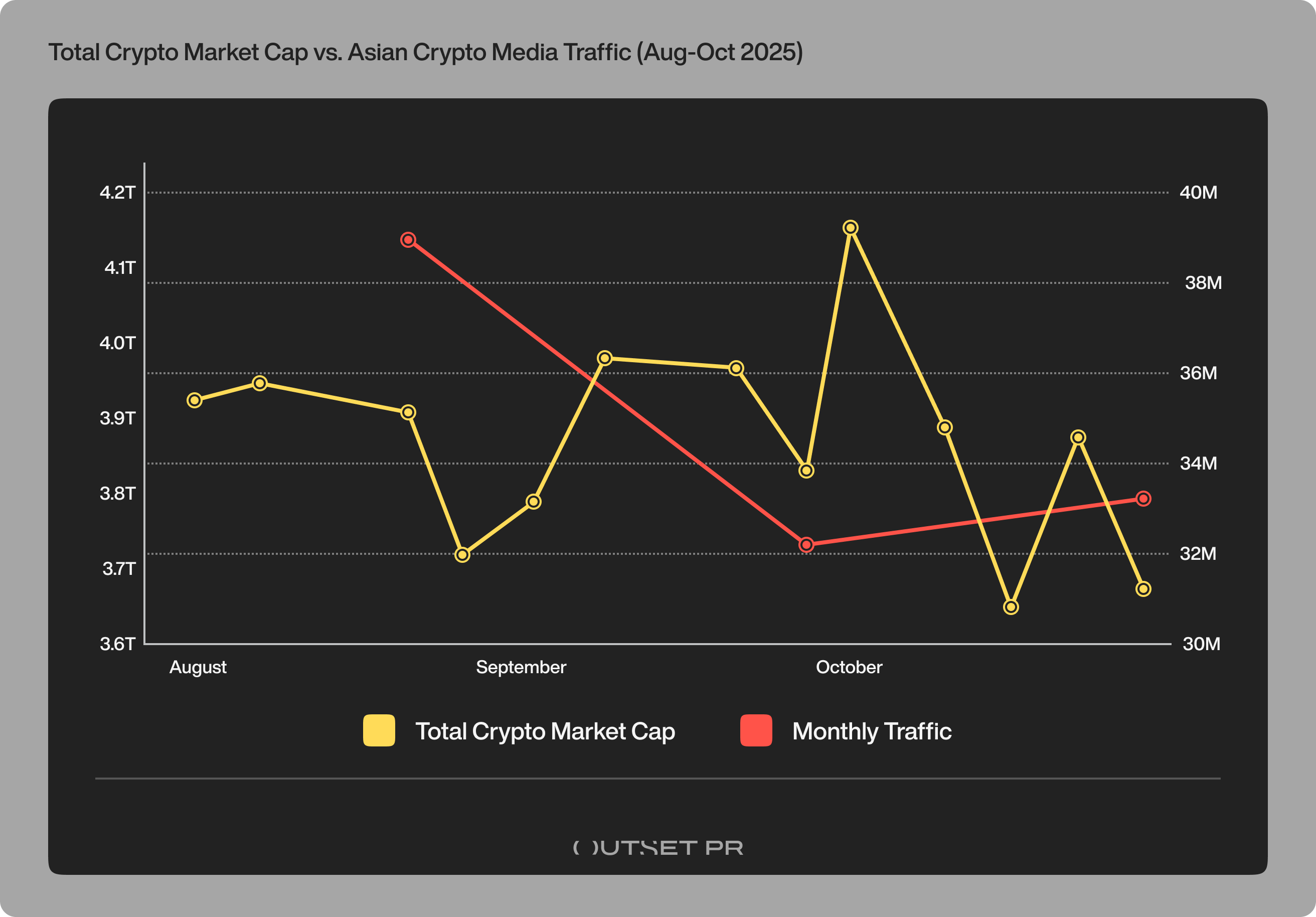
The primary driver of market thinning stemmed from several coinciding issues, the first being the exhaustion of the "corporate treasury" narrative. The hype cycle that buoyed Bitcoin in early summer ran out of kinetic energy, leaving retail participants with neither volatility to exploit nor the simple logic of continuous price appreciation.
Additionally, major assets chopped sideways while altcoins suffered a brutal bleed-out. Stagnation rendered the charts unwatchable for all but the most committed participants, effectively severing the dopamine feedback loop that previously sustained transient traffic.
For these committed participants, algorithmic discovery is unnecessary. Direct visits accounted for 54.38% of the total, indicating that the majority of the audience now bypasses algorithmic discovery to seek specific information intentionally. Habitual behavior of this magnitude shows that speculators evaporate when the euphoria fades, leaving only those with genuine skin in the game to consume the signal.
Consolidation at the apex stalls as the mid tier feeds on the edges
Although overall traffic figures have cooled, the underlying data shows a market prioritizing value over volume. The ecosystem remains defined by a “power law” structure where a small number of giants dominate readership, yet momentum is shifting. Diversification now opens distinct lanes for visibility across different levels of influence.
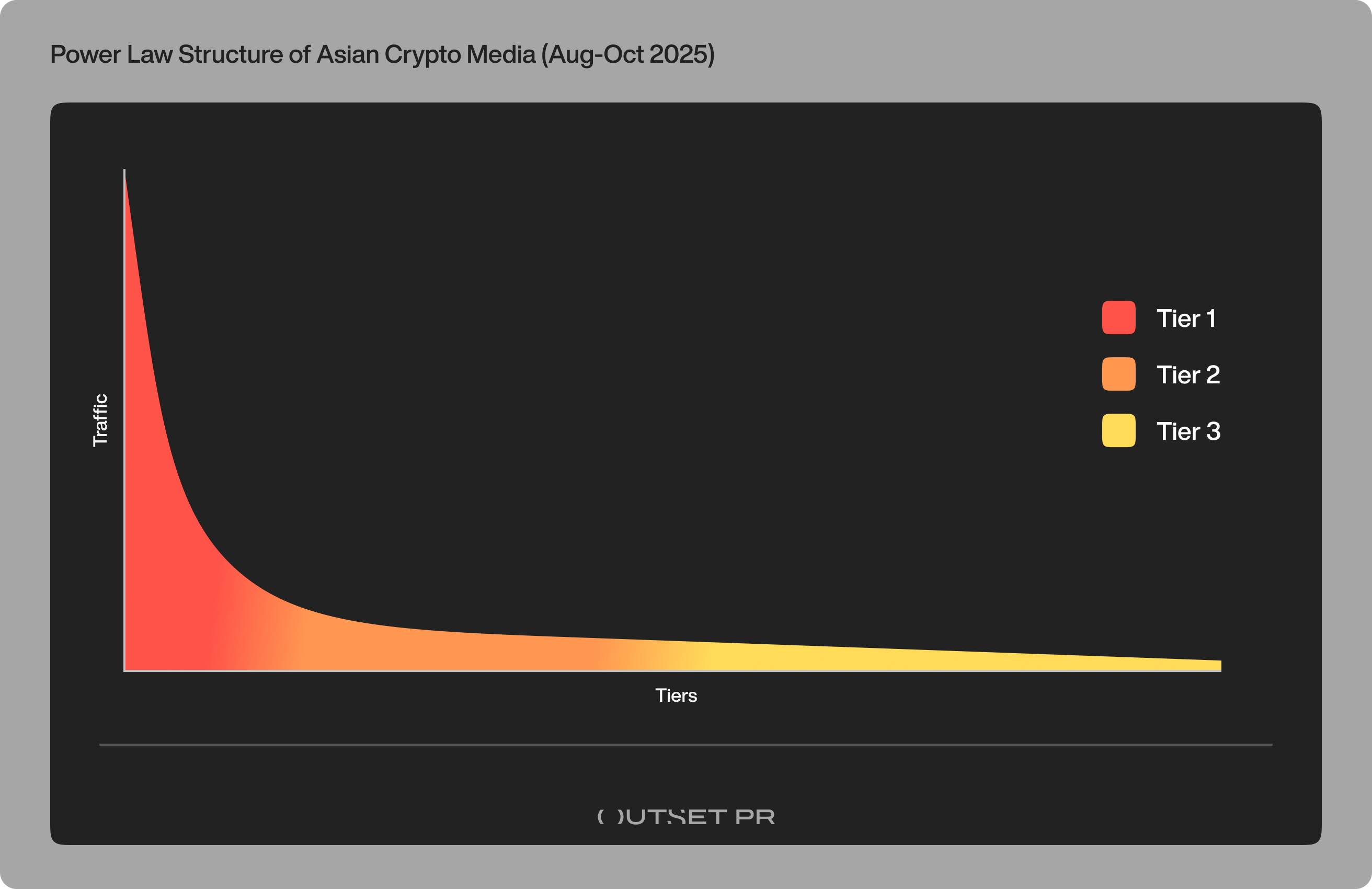
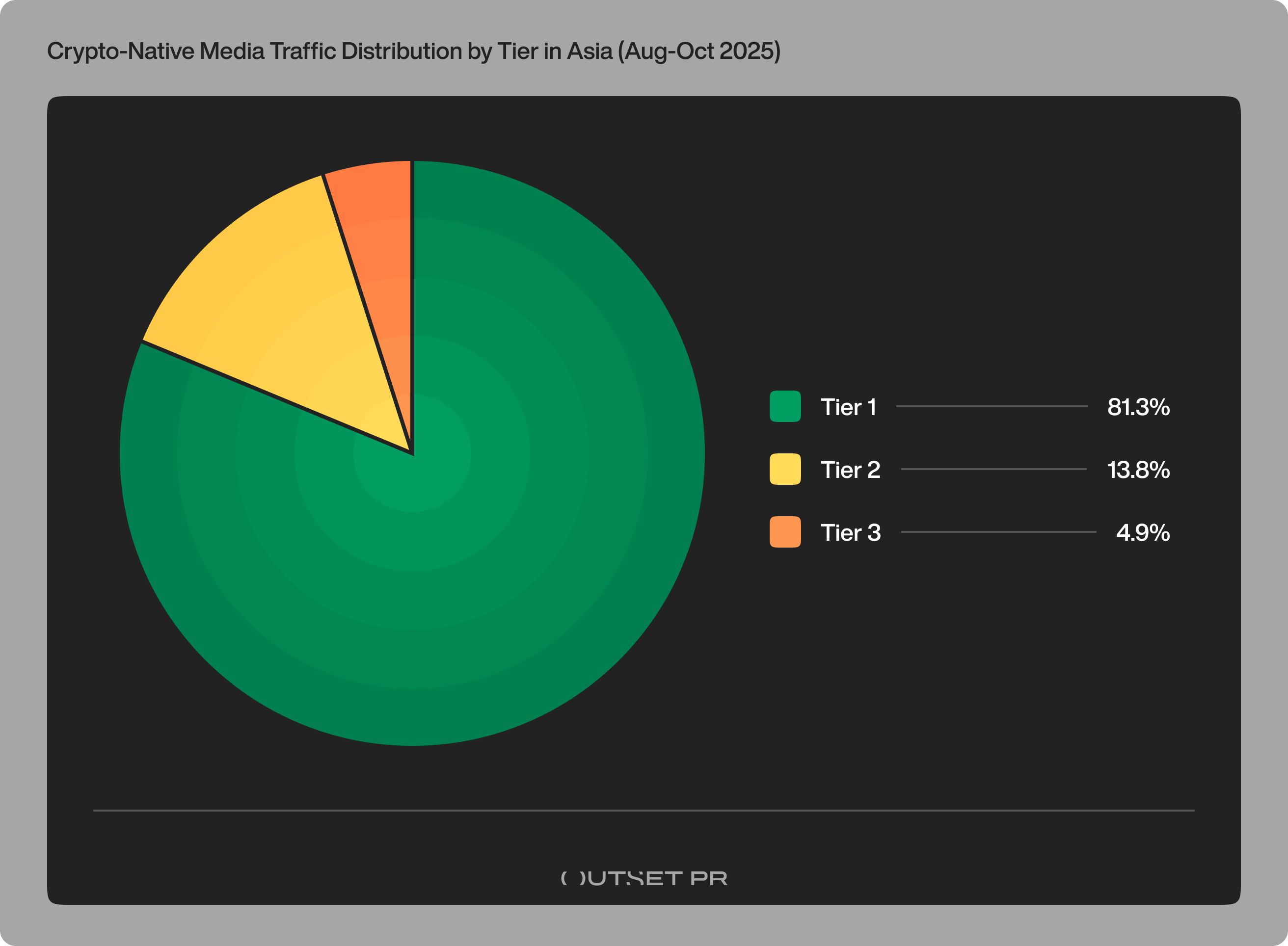
The Tier 1 cohort, comprising 20 outlets exceeding 400K monthly visits, functions as the ecosystem’s defensive bedrock. Collectively amassing 85.46M visits, this group commanded 81.25% of all crypto-native traffic. Continued dominance confirms that market leaders like CoinReaders, Coinpan, BlockMedia, and CoinPost serve as the primary infrastructure for mass awareness.
Market share for the group remained virtually flat compared to Q2, indicating that audiences in a low-volatility environment retreat to familiar brands rather than exploring new sources. Established platforms provide the necessary “air cover” for narratives by offering credibility and a broad reach that smaller outlets cannot match.
Dynamic activity concentrated within the Tier 2 segment, defined by outlets generating between 130K and 400K visits. Emerging as the structural growth engine for the three-month period, this cohort expanded to 21 outlets and captured 14.53M visits and grew its market share to 13.82% from 11.95% in Q2.
Our analysis reveals that the Tier 2 audience is far more engaged: on average, users visit 7 pages per session, nearly triple the rate of Tier 1 (2.5 pages), and spend 32.6% more time on site (2.42 min vs. 1.82 min)
Platforms like TechFlow Post, Siam Blockchain, and Techub News effectively capture high-intent traffic by serving readers actively researching projects rather than passively consuming headlines. Brands can view this tier as a key opportunity for conversion.
The Tier 3 sector, consisting of 40 outlets with fewer than 130K monthly visits, recorded 5.20M visits, representing 4.94% of the regional total. Far from irrelevant, the tier reinforces the extreme specialization observed in Q2 as a primary survival mechanism.
Outlets like Followin and Coin98 persist because they function as critical infrastructure for specific niche communities. Rather than competing on broad traffic, the platforms own specific verticals, whether DeFi protocols, GameFi, or local regulatory updates.
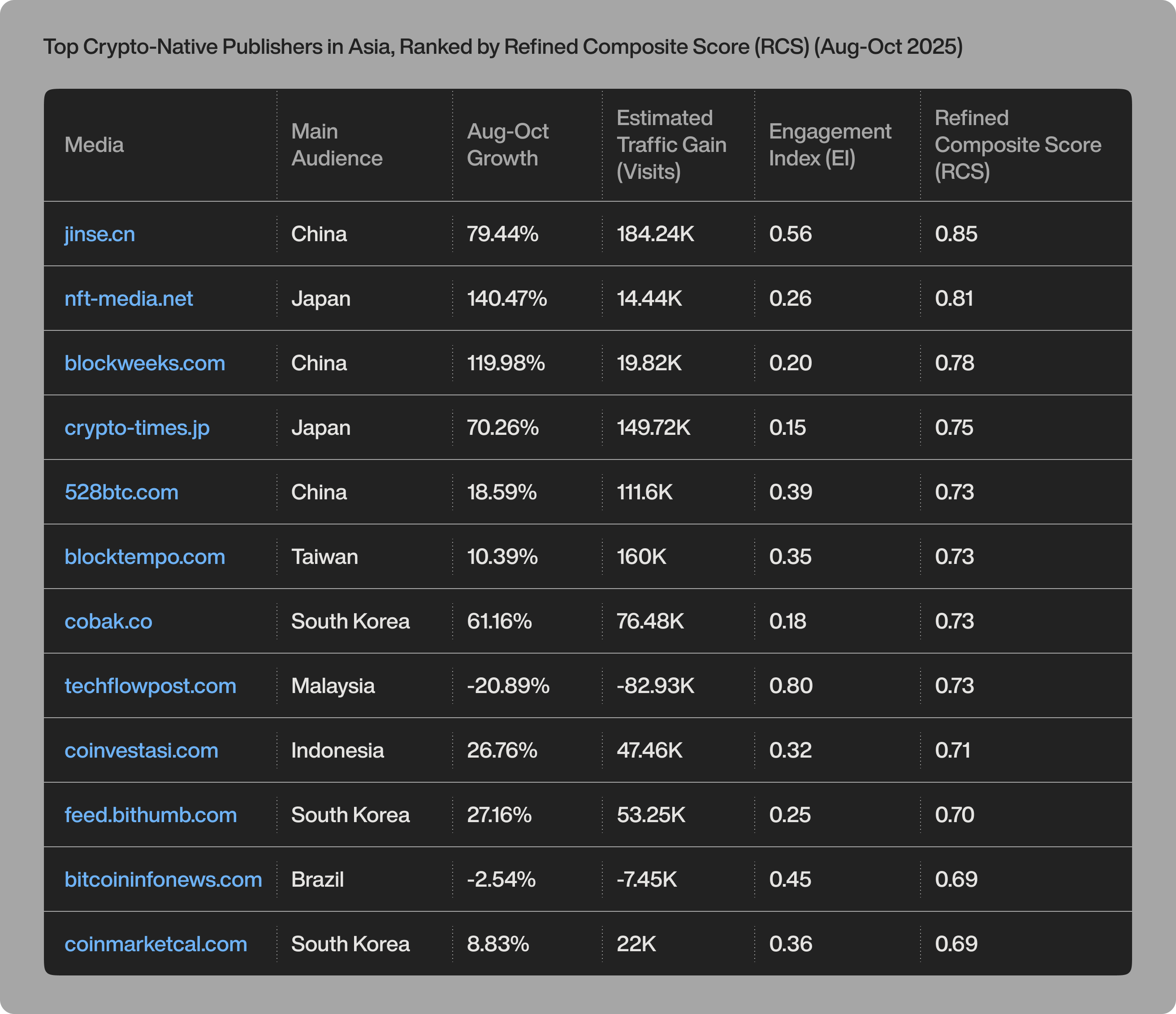
Top 10 crypto-native publishers in Asia (August-October 2025)
Based on our Refined Composite Score metric, here are the Top 10 crypto-native publishers in Asia for August-October 2025.
The list reveals two dominant success patterns:
- Growth-driven newcomers: Publishers with extraordinary traffic acceleration (70%+ three-month growth) leveraging niche positioning and algorithmic adaptability. These outlets demonstrate that explosive growth is still possible in a contracting market when content resonates with high-intent audiences.
- Resilient market leaders: Established tier-1 outlets maintaining scale through direct traffic loyalty and diversified referral channels. Despite overall traffic declines across the ecosystem, these publishers proved their staying power through loyal readership.
1. Jinse.cn – Leading Chinese diaspora platform with 79.44% growth
Main audience: China and Hong Kong
Traffic performance: 886.28K visits (79.44% Aug-Oct growth)
Direct traffic: 66.87%
Visit duration: 9.68 min
Pages/visit: 2.49
Bounce rate: 45.97%
Organic traffic: 19.73%
Jinse.cn's ascent to the top position reflects a strategic pivot toward deeper engagement and cross-border positioning. With an 79.44% August-to-October growth rate, the outlet nearly doubled its traffic while maintaining exceptional content depth, the highest average session duration in the top 10 at nearly 10 minutes.
The platform's success stems from three converging factors:
- dominant direct traffic at 66.87%, signaling cultivated audience loyalty among Chinese-speaking communities,
- organic search contributions at 19.73%, proving consistent SEO optimization despite algorithmic unpredictability,
- a multi-page browsing pattern (2.49 pages per visit) that indicates editorial depth exceeding typical crypto news consumption patterns.
Notably, Jinse's low AI referral contribution (0.54%) suggests the platform has not yet prioritized structured data optimization, yet its organic strength indicates foundation building that could unlock AI visibility in future months. The outlet's referral traffic (11.76%) likely streams from cross-border financial communities and regional fintech networks.
Takeaway: Jinse.cn exemplifies how deep, localized content serves underserved diaspora audiences seeking bilingual crypto intelligence. Its trajectory suggests that cross-border positioning, rather than pure geographic focus, may become a defining advantage in Asia's fragmented mediascape.
2. NFT-Media.net – Japan-focused niche outlet with 77% AI-driven referrals
Main audience: Japan (NFT and gaming focus)
Traffic performance: 45.86K visits (140.47% Aug-Oct growth)
Direct traffic: 33.40%
Visit duration: 2.07 min
Pages/visit: 2.23
Bounce rate: 52.73%
Organic traffic: 59.99%
NFT-Media.net's second-place RCS ranking represents one of the most extreme growth trajectories in the dataset, a 140.47% increase over three months. The explosive expansion occurred despite total traffic volumes remaining in the sub-50K monthly range, indicating highly concentrated audience acquisition.
The outlet's defining characteristic is its asymmetric reliance on AI discovery channels. AI referrals account for 77.01% of all inbound traffic, by far the highest proportion in the top 10.
In other words, the publisher has engineered content specifically for machine curation: structured metadata, optimized summaries, and AI-friendly formatting have become its primary distribution layer.
The outlet's moderate session duration (2.07 minutes) and pages-per-visit (2.23) align with typical AI-summarized content consumption patterns, where readers seek rapid context extraction rather than narrative depth.
Organic search contributes 59.99%, indicating strong SEO positioning within its NFT gaming niche. Direct traffic remains modest at 33.40%, suggesting the outlet has not yet cultivated habitual return readership, which is a characteristic distinguishing growth-driven new entrants from brand loyalists.
Takeaway: NFT-Media.net's model represents the emerging "AI-first" publisher archetype, where algorithmic visibility substitutes for brand recognition. This strategy delivers explosive short-term growth but poses questions about audience stickiness and long-term dependency on AI algorithm changes.
3. Blockweeks.com – Emerging Chinese player posting 119.98% growth
Main audience: China
Traffic performance: 75.18K visits (119.98% Aug-Oct growth)
Direct traffic: 24.76%
Visit duration: 0.72 min
Pages/visit: 1.51
Bounce rate: 54.29%
Organic traffic: 65.16%
Blockweeks occupies a middle position between rapid-growth specialists and engagement-driven incumbents. With a 119.98% August-to-October rise, the outlet achieved the third-highest growth rate in the top 10, yet its total traffic footprint remains modest at under 100K monthly visits. Its profile characterizes a rising niche player scaling through specialized content coverage rather than mass-market appeal.
Additionally, Blockweeks's low engagement metrics (0.72 minute sessions, 1.51 pages per visit) indicate a "headline-scanning" audience model, likely driven by keyword-targeted organic traffic (65.16%) rather than repeat readers seeking depth. Its reliance on organic search over direct traffic (24.76%) suggests it has not yet built brand equity sufficient to drive habitual return visits, which is a limitation but also an opportunity for future loyalty expansion.
Alongside that traffic profile, Blockweeks shows emerging AI integration at 10.56% of referral traffic, positioning it ahead of more established outlets in algorithmic adaptability. Combined with strong organic visibility, AI-sourced referrals suggest active experimentation with content structure and distribution ahead of broader AI adoption curves.
Takeaway: Blockweeks represents the emerging class of growth-stage publishers that leverage SEO expertise and niche positioning to achieve rapid traffic acceleration. Success will depend on converting headline scanners into habit-forming readers through community engagement or differentiated analysis.
4. Crypto-Times.jp – Japan-based outlet built on a speed-first model with 70.26% growth
Main audience: Japan
Traffic performance: 814.8K visits (70.26% Aug-Oct growth)
Direct traffic: 28.83%
Visit duration: 0.92 min
Pages/visit: 1.53
Bounce rate: 66.75%
Organic traffic: 60.11%
Crypto-Times.jp achieved 70.26% August-to-October growth while building an audience of over 815K visits through primarily organic discovery (60.11%). It keeps successfully navigating the transition from nascent market player to established mid-tier outlet.
The outlet's elevated bounce rate (66.75%) and brief session duration (0.92 minutes) reflect Japan's dominant consumer behavior: readers seek rapid price updates, regulatory news, and exchange announcements rather than narrative journalism.
Despite low engagement depth, the outlet's traffic acceleration suggests that algorithmic systems (particularly Google News aggregation for financial topics) are funneling readers through Crypto-Times' Japanese-language breaking news.
Direct traffic remains low at 28.83%, showing limited brand loyalty among casual visitors. However, the outlet's 70% growth trajectory suggests early-stage conversion of algorithmic traffic into repeat readership, particularly as Japanese retail investors rotate toward reliable information sources during market uncertainty.
Takeaway: Crypto-Times exemplifies the “speed-first” publisher model dominant in Japan, where regulatory shifts and exchange announcements drive readership spikes. Growth depends on consistent coverage velocity and algorithmic prominence, and not on audience attachment to a distinctive editorial voice.
5. 528BTC.com – Largest Chinese outlet with consistently deep engagement
Main audience: China
Traffic performance: 1.85M visits (18.59% Aug-Oct growth)
Direct traffic: 56.89%
Visit duration: 5.02 min
Pages/visit: 2.52
Bounce rate: 46.25%
Organic traffic: 40.32%
528BTC enters the top 10 as the highest-traffic tier-1 outlet in the ranking, demonstrating that large-scale audiences and superior engagement metrics can coexist. With 1.85M total Aug-Oct visits and a respectable 18.59% growth rate, the publisher combines established scale with ongoing audience expansion.
The platform's 5.02-minute sessions and 2.52 pages per visit position it among the deepest reader engagement in the dataset. It differentiates 528BTC from headline-driven competitors and suggests content that serves analytical or investment-decision functions rather than entertainment or social sharing.
Direct traffic dominance (56.89%) confirms established brand loyalty within China's crypto investor community, while organic search contributes 40.32%, indicating strong SEO authority accumulated over multiple years.
Notably, AI referrals account for only 2.24% of traffic, suggesting the platform has not yet adopted AI-optimization strategies, yet maintains growth despite this gap. This pattern indicates that 528BTC's success depends primarily on loyal, intentional visitation rather than algorithmic distribution.
Takeaway: 528BTC demonstrates that deep engagement and audience loyalty can sustain growth even as overall market traffic contracts. The outlet's 18.59% rise, the highest among large-scale publishers, suggests that quality content capturing high-intent readers remains defensible against algorithmic unpredictability.
6. BlockTempo.com – Taiwan-based platform using a diversified discovery strategy
Main audience: Taiwan and China
Traffic performance: 4.75M visits (10.39% Aug-Oct growth)
Direct traffic: 34.31%
Visit duration: 2.62 min
Pages/visit: 2.01
Bounce rate: 38.95%
Organic traffic: 59.14%
BlockTempo ranks among the largest traffic publishers in the top 10, accumulating 4.75M visits while maintaining modest positive growth (10.39%) in a contracting market. All of this positions the outlet as a market stabilizer, or, in other words, as a publisher that retains readers while scaling reach.
The platform's defining strength lies in algorithmic adaptability. AI referrals contribute 15.10% of traffic, among the highest in the top 10, indicating deliberate content optimization for machine curation systems.
Diversified traffic sources, 34.31% direct, 59.14% organic, and 15.10% from AI referrals, provide strong protection against dependency on any single channel, driving BlockTempo’s stability during episodes of algorithmic turbulence.
With an average session depth of 2.62 minutes and 2.01 pages per visit, BlockTempo occupies a “moderate engagement” niche, offering deeper interaction than short-form news-flash competitors while remaining more accessible than long-form analysis platforms. This balanced position highlights editorial flexibility, combining timely reporting with thoughtful commentary to engage both casual followers and dedicated researchers. A 38.95% bounce rate, lower than most Asian peers, further indicates that returning users consistently locate content aligned with their interests.
Takeaway: BlockTempo exemplifies the "diversified discovery" strategy that enabled large publishers to sustain growth during market contraction. By deliberately optimizing for AI, organic search, and direct loyalty, the platform hedged against algorithmic disruption that devastated single-channel dependent competitors.
7. Cobak.co – South Korea mobile-first platform showing rapid growth
Main audience: South Korea
Traffic performance: 462.37K visits (61.16% Aug-Oct growth)
Direct traffic: 61.01%
Visit duration: 0.77 min
Pages/visit: 2.38
Bounce rate: 58.97%
Organic traffic: 29.38%
Cobak.co ranks among the fastest-growing publishers in the top 10, achieving 61.16% three-month traffic expansion from a tier-2 base. The outlet's success model diverges from algorithmic-first competitors, instead emphasizing direct traffic loyalty and rapid page transitions, which is a distinctly Korean publisher strategy.
Its direct traffic dominance (61.01%) rivals established market leaders and indicates early-stage conversion of casual visitors into habitual readers. Despite sessions averaging only 0.77 minutes, the outlet achieves substantial pages-per-visit (2.38), suggesting readers move rapidly through related stories rather than dwelling on single articles. This behavior aligns with mobile-first consumption patterns prevalent in South Korea's high-smartphone-penetration market.
Organic traffic contributes 29.38%, indicating solid SEO positioning. However, the outlet's minimal reliance on AI referrals (0.22%) suggests Cobak has not yet adapted to AI-driven discovery, instead competing primarily on speed and topic relevance within traditional search and direct channels. On one side, the gap presents risk (vulnerability to algorithmic shifts), but on the other, it presents an opportunity (untapped AI growth potential).
Takeaway: Cobak represents the rising class of Korean publishers leveraging rapid content cycles and direct loyalty to achieve explosive growth without algorithmic dependence. Sustainability depends on converting mobile-first casual readers into habitual daily visitors before competitors saturate the market.
8. Coinvestasi.com – Indonesia platform driven by an SEO-dominant model
Main audience: Indonesia
Traffic performance: 569.99K visits (26.76% Aug-Oct growth)
Direct traffic: 23.62%
Visit duration: 0.5 min
Pages/visit: 1.84
Bounce rate: 28.35%
Organic traffic: 72.62%
Coinvestasi achieves strong growth (26.76%) through a radically different model than engagement-focused competitors. Despite achieving the lowest session duration in the top 10 (0.5 minutes) and minimal pages-per-visit (1.84), the outlet demonstrates strong traffic expansion due to optimization for rapid content scanning and algorithmic discovery.
Its core strength sits in organic search, accounting for 72.62% of traffic, the highest share across the entire top 10. Search dominance shows strong SEO authority within Indonesian crypto investment queries, supported by disciplined content structuring around local language usage, location-specific intent, and tightly defined topic silos. As a result, Coinvestasi’s audience skews toward early-stage or less sophisticated investors seeking foundational crypto education.
Direct traffic remains limited at 23.62%, pointing to weak habitual readership. Even so, a low bounce rate of 28.35% indicates effective retention of first-time visitors arriving via search, establishing a credible base for future repeat-visit and brand loyalty development.
Takeaway: Coinvestasi demonstrates that organic search optimization within underserved markets can drive substantial growth without engaging format requirements. Success depends on maintaining SEO authority and gradually converting organic traffic into reader loyalty through community engagement or exclusive content.
9. Feed.Bithumb.com – South Korea exchange-integrated media ecosystem
Main audience: South Korea
Traffic performance: 744.73K visits (27.16% Aug-Oct growth)
Direct traffic: 82.79%
Visit duration: 1.63 min
Pages/visit: 4.4
Bounce rate: 53.14%
Organic traffic: 10.08%
Feed.Bithumb.com has a distinctive success model: maximum direct traffic dependency (82.79%, highest in the entire top 10) combined with exceptional pages-per-visit (4.4), meaning readers arrive with clear purchase intent or trading objectives. As a branded content feed of Bithumb (South Korea's largest centralized exchange), the outlet functions as an integrated information layer within a trading ecosystem.
The platform's 82.79% direct traffic concentration creates solid efficiency: readers bypass algorithmic discovery entirely, arriving with clear information needs and consuming multiple related pages (4.4 per visit). This ecosystem-integrated model explains the outlet's 27.16% traffic growth despite organic search contributing only 10.08%.
Bithumb Feed's vulnerability lies in its dependence on Bithumb's user base and trading volume. Platform-specific content feeds cannot expand beyond their host ecosystem without substantial editorial investment. However, within the Korean trading community, Bithumb Feed enjoys near-monopoly status for integrated exchange-native information, insulating it from direct competitor pressure.
Takeaway: Bithumb Feed exemplifies the “ecosystem-integrated” content model, where publishers merge with trading or investment platforms to achieve unparalleled direct traffic efficiency. While growth is bounded by platform user expansion, engagement, and monetization efficiency often exceed those of independent competitors.
10. CoinMarketCal.com – South Korea-based utility-first event platform with the highest dependence on AI-driven referrals.
Main audience: South Korea
Traffic performance: 772.55K visits (8.83% Aug-Oct growth)
Direct traffic: 52.28%
Visit duration: 2.13 min
Pages/visit: 4.0
Bounce rate: 34.76%
Organic traffic: 33.71%
CoinMarketCal.com rounds out the top 10 as a calendar-and-event-focused information platform bridging entertainment and utility. With 772.55K total Aug-Oct visits and steady 8.83% three-month growth, the outlet has cultivated a dedicated audience within the Korean crypto community. The platform's positioning as a centralized source for cryptocurrency events, token listings, and trading opportunities creates sticky usage patterns distinct from news-oriented competitors.
Its defining characteristic is exceptional AI integration. AI referrals contribute 53.41% of all inbound traffic, the highest proportion in the top 10, exceeding even NFT-Media.net. This concentration reflects CoinMarketCal's optimization for machine discovery: structured event data, calendar metadata, and AI-friendly formatting position the platform as a machine-readable source for crypto event information.
Notably, despite minimal direct traffic (52.28%) and heavy AI dependence, the platform achieves strong engagement metrics: 2.13-minute sessions and 4.0 pages per visit suggest readers consume multiple events or related data within single browsing sessions.
Organic search drives 33.71% of traffic, which points to solid SEO authority around event-query keywords. Visitors who arrive via search tend to stick. A 34.76% bounce rate, the 2nd-lowest in the top 10, suggests they quickly find relevant calendar entries and related opportunities. Social adds another 6.74%, as it fits a community layer where people share upcoming crypto events, token launches, and trading announcements. Together, search brings high-intent users and social adds momentum around time-sensitive listings.
Takeaway: CoinMarketCal exemplifies the "utility-first" publisher model gaining prominence in Asia's crypto markets. By prioritizing machine-readable event data and AI optimization over narrative content, the platform achieves disproportionate engagement through algorithmic visibility while maintaining modest but predictable traffic growth.
Note: Both TechFlowPost.com and BitcoinInfoNews.com were excluded from the final rankings due to negative three-month growth trajectories. TechFlowPost recorded a -20.89% decline despite maintaining the strongest engagement metrics in the dataset (5.75-minute sessions, 103.4 pages per visit).
BitcoinInfoNews.com, meanwhile, declined -2.54% while relying heavily on volatile social discovery channels (80.11% of traffic), compounded by its Brazilian geographic base outside Asia's primary study region. The exclusion methodology prioritizes positive growth expansion as a core signal of publisher resilience and market adaptation, particularly in periods of ecosystem-wide contraction where growth becomes a differentiating factor among competitors.
South Korea retains the top spot as 4 markets capture 78.54% of Asia’s crypto-native audience
South Korea generated 53.73M visits, equal to 51.08% of total tracked traffic. Taiwan ranked second with 11.19M (10.64%), Japan followed with 10.45M (9.93%), and Indonesia added 7.25M (6.89%). Combined, those four markets produced 78.54% or more than 3/4 of all Aug–Oct visits, leaving 21.46% for the remaining markets in the sample.
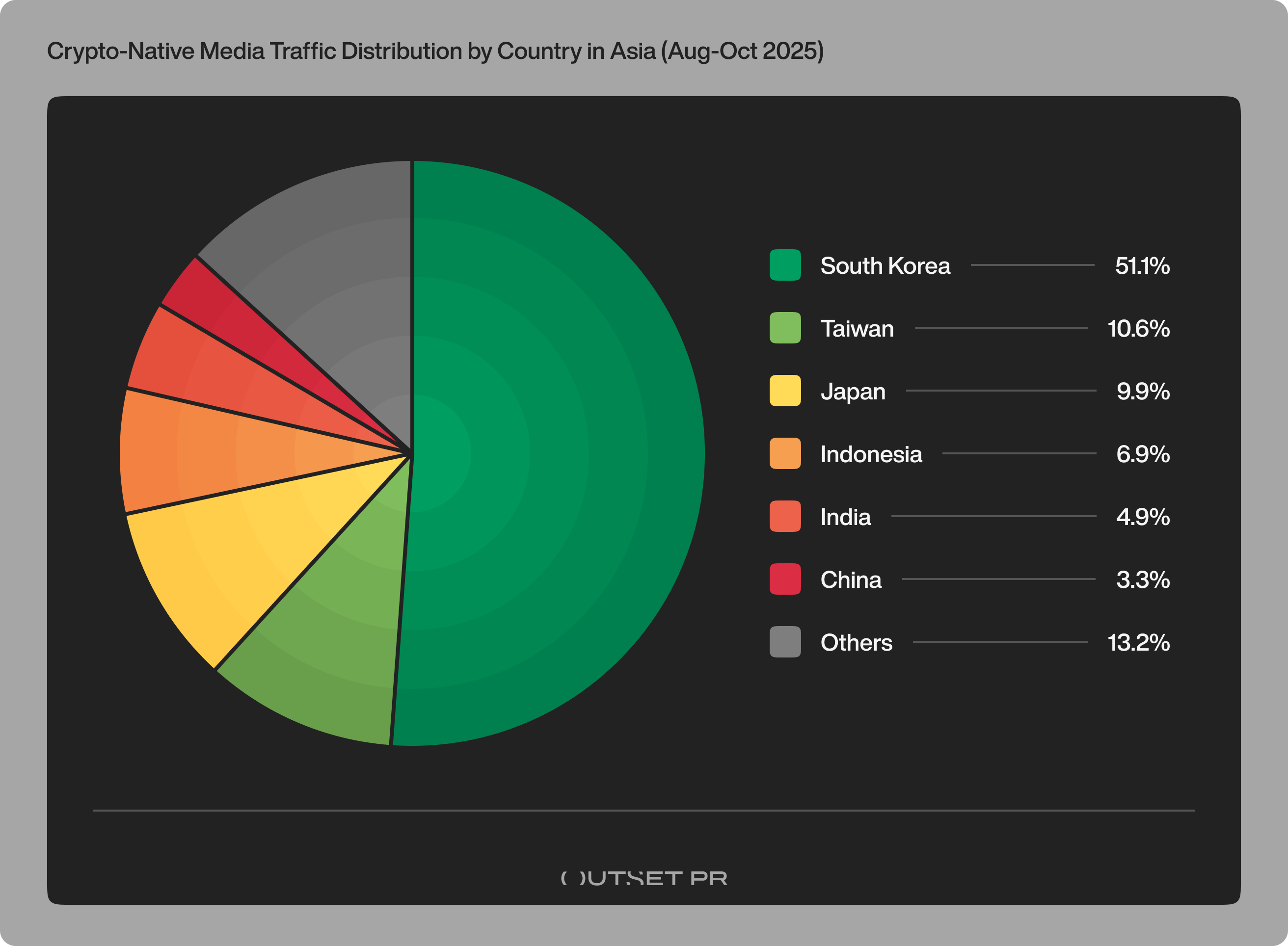
Audience reach, therefore, concentrates on a small set of mature local ecosystems. Regional narratives do not spread evenly across Asia. Korean readership alone can tilt “Asia-wide” perception in dashboards, press recaps, and search visibility. Taiwan and Japan add meaningful scale, but brands that treat Asia as a single distribution pool will over-allocate to generic regional messaging and under-allocate to country-native packaging.
Key drivers of Asia’s August-October media growth
We identified five repeatable growth levers that separated winners from the pack.
1. AI referrals as a distribution multiplier
Outlets with AI referrals equal to or exceeding 15% posted +2.90% median growth. Outlets below that threshold posted -11.22% median growth. AI surfaces rewarded clean structure, explicit entities, and machine-readable layouts.
2. Local-language SEO capture
Outlets with organic traffic equal to or exceeding 50% delivered +2.91% median growth versus -11.43% for the rest. Search kept sending high-intent readers to outlets that owned local keywords, evergreen explainers, and fast coverage of market-specific topics.
3. Referral networks and syndication effects
Outlets with referral traffic equal to or exceeding 10% reached +5.50% median growth. Partner ecosystems, cross-links, and community hubs replaced broad social distribution as a steadier acquisition rail during the cooldown.
4. Platform-native distribution and community loops
Exchange feeds and app-first communities converted existing user bases into recurring visits. Aug-Oct winners in Korea showed the pattern: strong growth with high direct traffic, plus fast story hopping across multiple pages per session.
5. Utility-first pages that readers recheck
Calendars, listings, market dashboards, and other “lookup” formats created repeat usage. Utility also pairs well with AI discovery because machines cite structured data more often than narrative prose.
Go deeper with the full data
This Asia edition represents the newest release in the Outset Data Pulse series, which tracks structural changes inside regional crypto media ecosystems over time. Each release aims to move beyond surface rankings and toward a measurable view of media resilience, audience quality, and long-term relevance.
The current report highlights 10 leading outlets in Asia, yet the underlying framework scales across the full dataset of 81 publishers. Coverage spans crypto-native platforms and mainstream media with active crypto desks. Each outlet includes a standardized set of behavioral metrics such as total visits, unique users, session duration, pages per visit, and bounce rate. Granularity at that level enables cross-market comparisons that go far beyond traffic volume alone.
Access to the complete dataset allows several advanced use cases:
- Users can reproduce rankings for all 81 outlets or isolate specific geographies, languages, or business models.
- Analysts can monitor changes in engagement quality and audience consistency across reporting periods.
- Researchers can stress test assumptions by redefining outlet cohorts and re-normalizing RCS and EI outputs using the formulas outlined in the methodology.
The dataset also functions as a strategic signal for the broader crypto industry rather than a narrow analytics product.
- PR and communications teams gain clarity on where authentic exposure compounds over time versus where attention decays.
- Growth and business teams can identify which regional channels translate visibility into sustained reach.
- Investors and researchers can examine the growing gap between user adoption and fragile media economics, surfacing structural risks alongside underpriced opportunities.
- Publishers and regulators can observe how AI-driven discovery, regulatory divergence, and market fragmentation reshape Asia’s crypto information layer.
Combined, these perspectives transform the dataset into a working reference for organizations that aim to build, defend, or scale influence across Asia’s crypto markets.
Outset PR applies the same intelligence internally, yet access remains open by design. Industry-level transparency strengthens the ecosystem as a whole and supports better decisions across media, capital, and policy.
As seen in: Archyde, Benzinga, Bitcoin Sistemi, Bitunikey, BlockchainReporter, Blockweeks, CapWolf, Crypto Daily, crypto.news, Crypto News, CoinMarketCap, Guia do Investidor, KuCoin, Metaverse Post, OvenAdd, The Crypto Updates.


