
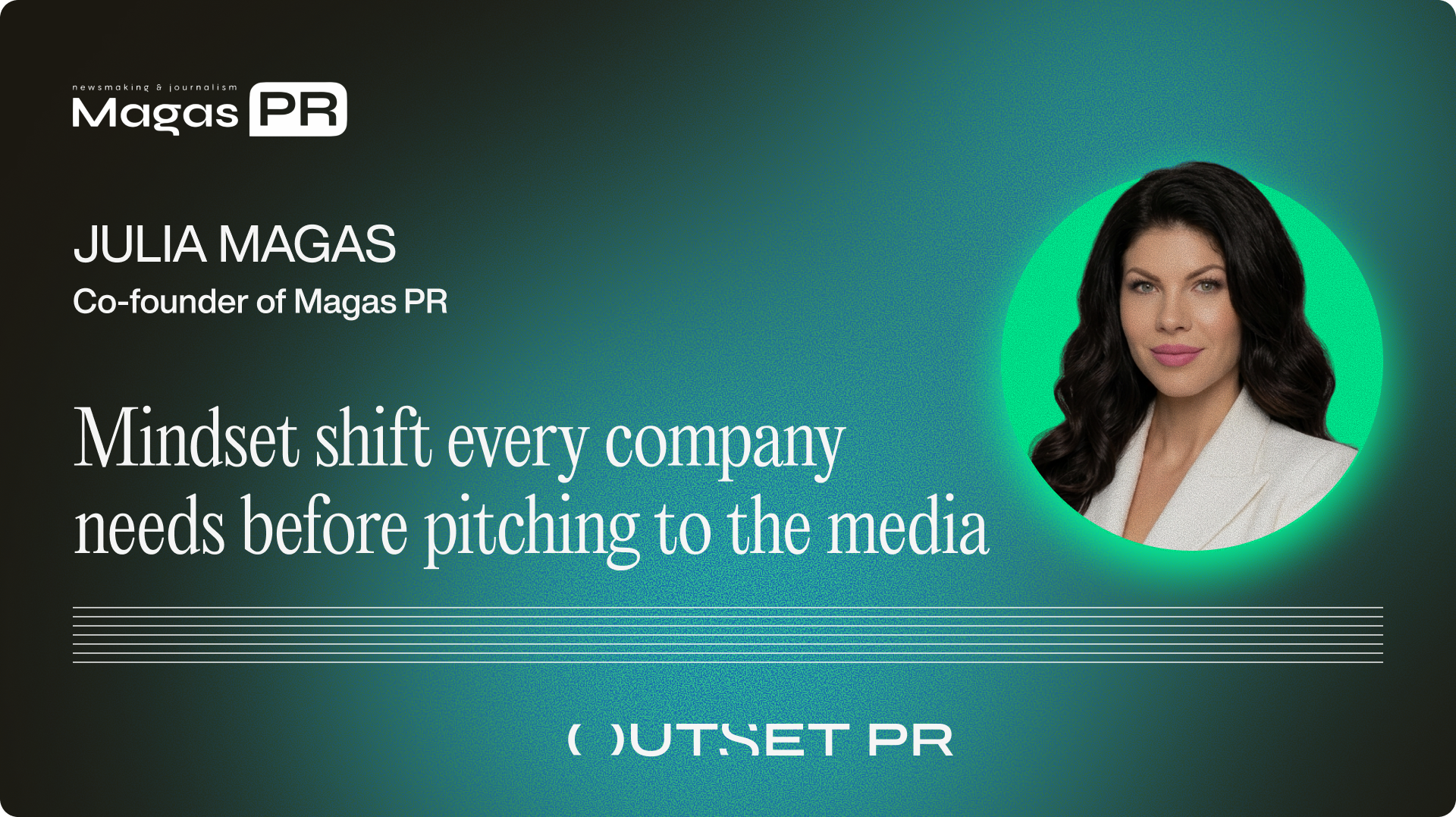
Julia Magas has spent years on both sides of the media equation. In addition to co-founding Magas PR, which specializes in newsmaking, thought leadership, and data-driven public relations, she has worked as a contributing author for Cointelegraph, Nasdaq, Investing.com, Seeking Alpha, and InvestorPlace.
That extensive journalistic experience gives her a rare perspective:
“It helps me [as a PR professional] better understand what's worth pitching to serious media outlets and what needs to be refined to make the pitch truly interesting and useful for the general reader,” Julia says.
She emphasizes that relevance, practical value, and sensation drive most editorial decisions. So the real match happens when a brand or a speaker adds at least one of those three to a journalist’s story.
Common gaps between founders, PR, and journalists
While that synergy is pretty straightforward at first glance, in practice, most pitches still fail for several reasons. First off, there’s a difference in how journalists and founders (or PR teams representing them) evaluate what actually deserves broad coverage.
“For a founder, a product launch, an investment round, a partnership, or a new feature may seem important simply because it's important to the company,” Julia clarifies.
But journalists, she argues, are not looking for companies to write about. They are looking for stories that matter to their readers – the ones that explain what's happening in the market, whether by revealing something new or challenging conventional wisdom.
Another part of that misconception is framing. According to Julia, many founders think that “journalists will spend a long time searching for the right angle within a corporate news story.”
In reality, editorial offices operate under constant time pressure, forcing reporters to quickly sort through incoming pitches based on their relevance. If there are no obvious hooks that demonstrate why this story is important, why now, and why specifically for this publication's audience, the basic check has already failed.
Julia also disagrees that a founder’s media footprint alone guarantees coverage. While she admits that the chances of being quoted increase for those who have previously appeared in other publications or regularly posted thought leadership content through social media, the quality of submitted perspective becomes equally important amidst the rise of AI.
“We've seen it many times: journalists may ignore public speakers if they use ChatGPT to write their commentary.”
Instead of offering something generic, Julia explains, founders have to focus on what sets them apart from others: the uniqueness of their own writing, the depth of analysis, and, occasionally, the boldness of their statements.
With all of that in mind, she claims good PR shouldn’t “force a company into the media cycle.” It should explore an outlet’s agenda, target audience, and the current market environment to identify where the brand can genuinely support the ongoing conversation and build natural ties between founders and journalists.
For that purpose, companies need more than just ambition. “A strong point of view, reliable data, useful expertise, or a story that connects to something larger than the company itself are essential,” Julia highlights.
Overpromotion is the fastest way to a journalist’s blacklist
If relevance is what earns attention, excessive self-promotion has the opposite effect. As Julia points out:
“Many founders are so eager to advertise themselves that they try to shout about their product even where it's inappropriate.”
She gives a simple example. If a media outlet asks for a comment about Bitcoin's price correction after an institutional sell-off, and halfway through the response the expert suddenly starts talking about a recent token listing, journalists quickly recognize when a source is more interested in promotion than insight. As a result, future pitches from that contributor could be out of sight for months.
Company mentions still work, but only when they come with “understanding and respect for the reader” – for example, through meaningful analytics on asset movements or user activity within your product.
When asked to share a recipe of an expert commentary that immediately stands out and makes a journalist's job easier, Julia recalls expanded op-eds that included new facts, real-life cases, figures, or a critical perspective on a topic. From her observation, these articles tend to spread to other media outlets, get cited, and create trends that spark public debates. In one case, journalists were so pleased by the input that they devoted the final article entirely to the author's opinion, and even featured their name in the headline.
Data as a shortcut to media visibility
At this point in our conversation, another question emerged: can a relatively unknown company still earn coverage in major media outlets?
Julia believes the answer is yes, and one of the most effective ways to do it is through original data that is specific, timely, and easy to interpret. This could be periodic statistics or comparisons that “reveal something the market can't easily see from public sources alone”:
- behavioural shifts,
- contradictions to a conventional narrative,
- regional differences,
- or hidden patterns that explain larger trends.
In her words, “journalists respond best to figures that show movement, contrast, or an unexpected finding.”
This is one of the few areas where smaller companies can compete directly with the scale, relevance, and awareness of well-known players. But that competition only makes sense when the underlying research is credible: methodology, sample size, geography, timeframe, and a clear reading of the numbers.
As Julia puts it: “Without these, statistics look like marketing masquerading as research.”
AI made expertise harder to prove
Many of the things we've discussed – creating pitches, responding to media requests, and producing opinion pieces – have become easy thanks to AI content tools. So easy that nowadays “anyone can present themselves as an expert.” Founders treat LLM apps like a cheat code that allows them to shape commentary in seconds, without writing skills, and, worst of all, deep expertise in a subject.
Yet Julia notes that this convenience created an unexpected problem for people trying to speak out: “The paradox is that AI has raised the bar for experts.”
Polished language alone no longer equals market understanding and the ability to trace cause-and-effect relationships. Rather it raises the opposite question: was this written by someone who is familiar with the topic, or by a machine trained to sound convincing?
Today, journalists receive huge volumes of AI-assisted content every day – and are becoming increasingly skeptical of expert inputs because they are more predictable and promotional than ever.
“A few years ago, a founder's commentary could be perceived as an inside look at a company. Now, journalists more often expect a founder to promote their product, their category, or their investment story,” Julia elaborates.
At the same time, what used to fail as a poorly worded comment, now goes to spam as another generated text without specifics or real thought, reading as “distorted data and often identical, meaningless responses devoid of humanity, expertise, and a critical eye.”
However, Julia doesn’t suggest that founder commentary has lost its value. It still helps people look at the market from the inside, if a speaker possesses everything AI struggles to replicate: firsthand experience, original observations, nuanced analysis, and informed judgment.
The challenge is particularly visible in sectors like AI and crypto, where journalists often work against the clock and stories can evolve by the hour. Speed matters, sometimes enormously, but being first is no longer enough on its own. Per Julia, commentary must also be up-to-date, insightful, and rooted in genuine professionalism.
Be a source, not a promoter
Reflecting on the qualities that will characterize the most valuable experts and company spokespeople over the next few years, Julia named depth, specificity, independent thinking, and responsiveness.
- Depth means the person has a grounded view of the sector and isn't simply repeating popular talking points.
- Specificity means they can provide a figure, an example, a comparison, a practical observation, or a clear conclusion.
- Independence of thought means having enough courage to say something counterintuitive, as long as it's well reasoned.
- Responsiveness means being able to provide quality input while the news is still fresh, not three days later.
As our conversation came to a close, Julia returned to a theme that had quietly run through every part of the discussion. The strongest advice she shared had little to do with pitching tactics, media operations, or personal brand development. It was about mindset:
“Stop thinking of the media as a promotional channel and start thinking of yourself as a source of useful market insight.”


