
Some brands can focus on marketing once the product is live because users are already familiar with the category and feel more confident trying it. Others, like frontier technology companies, need a recognizable story much earlier, while the underlying work is still moving through research, testing, and prototype development.
Founded in 2021, XPANCEO is engineering a smart contact lens that could one day replace personal devices and secure its place in the next generation of computing. In 2025, the company raised $250 million in Series A funding at a $1.35 billion valuation, achieving unicorn status, and that kind of momentum doesn’t come from building alone. At this stage, external communication becomes part of how the brand proves that the category itself can exist.
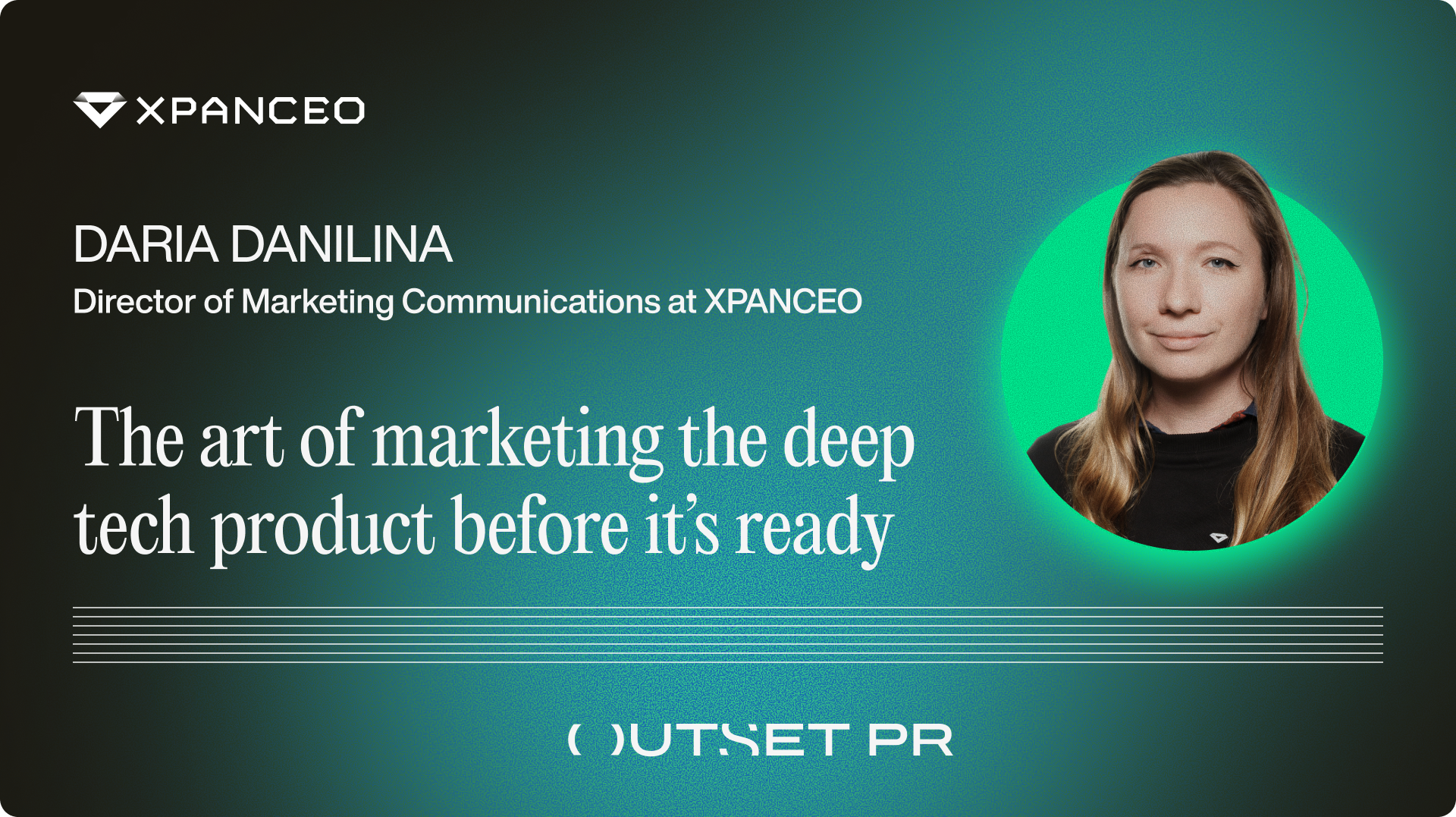
That’s what I wanted to learn from Daria Danilina who leads XPANCEO’s marketing communications: how a team turns lab progress into a public narrative, engages journalists before the lens is widely available, and earns trust for something people can’t yet fully experience.
The product that changes the nature of communication
“You can only bring a message to the market once you understand internally what you’re trying to say.”
This approach to narrative-building helped the brand avoid a common trap for R&D-driven projects: standing out for impressive science while struggling to turn it into a compelling product story.
Daria points out that XPANCEO started as a product company rather than a scientific experiment, even though its core development was still in the exploratory and engineering phase. That forward-looking vision helped unify the company’s language, from positioning and pitch to broader messaging.
“The real work was explaining what problem we solve, why it matters, why the lens isn’t just another gadget, and how it fits into the new generation of computing.”
Daria notes that keeping their story consistent is an ongoing effort: “The technology, prototypes, and market evolve. So does the narrative.”
Consistency here is less about repeating the same slogans and more about making sure every public-facing layer – from the website and social channels to media, demos, and conferences – reflects the actual point of the technology. The people behind PR, strategy, key narratives, and content need to grasp:
- which prototypes exist;
- how they work;
- what stage they are at;
- what the technical limitations are;
- what can and can’t be said externally.
Technical awareness is fundamental for deep tech comms
That’s why communications at XPANCEO go hand in hand with the research and development process itself.
“We stay deeply embedded in R&D through regular syncs, sprint reviews, and product updates, where they translate highly technical details into plain language. In this way, marketing accumulates a real understanding of the product instead of just sourcing answers on demand,” Daria reveals.
When marketers prepare any copy, they first work through internal materials and documentation. If something remains unclear, the conversation moves directly to product leads, engineers, or scientists responsible for that specific area. The finished materials undergo expert fact-checking to ensure the messaging is both accessible and technically precise.
“For us, a good text is one that a person outside science can follow, but after the R&D review, nobody says it's nonsense.”
This is important because deep tech communication can easily drift into oversimplification. The pressure to make a concept sound cleaner or more certain than reality creates long-term credibility risks.
Daria admits that not everyone in marketing needs the same depth of knowledge. Still, no one can work completely outside the main narrative. Designers, videographers, or event managers don’t have to think like engineers, but they do have to immerse themselves into the product background, the visual language, and the idea XPANCEO wants people to remember.
PR is essential for building trust before the product exists at scale
As the company doesn’t yet have a tangible product focused on conversions or direct sales, its marketing strategy is inherently communication-led. PR serves as a key driver of brand growth, trust, and education around what’s coming.
Events complement that strategy by helping XPANCEO expand its network, showcase prototypes, and establish strong industry connections. The team is also active on social media, where they maintain an open dialogue with audiences and highlight the company’s momentum through visual storytelling, mass-market trends, and business-focused content.
“Media, interviews, public appearances, and event participation all keep XPANCEO relevant across journalist, investor, partner, and wider market circles,” Daria elaborates.
According to her, communication becomes more product-driven as the technology moves closer to reality.
“At an earlier stage, we had to rely more heavily on the people behind the tech, the scientific method, and the category XPANCEO was trying to define.”
With more working demos to present, the team unlocked new ways to turn technical progress into belief ahead of actual release. That includes expanding into adjacent domains such as consumer electronics, healthcare, fashion, luxury, sports, and entertainment.
“This is how we demonstrate that the product could eventually enter people’s everyday lives and create new use cases,” Daria explains. “At the same time, we’re not trying to be everywhere for the sake of visibility. We choose industries that have a natural connection to the lens, its future applications, or potential partnerships.”
A live demo can do what messaging alone can’t
Direct access is now XPANCEO’s strongest trust-building tool. The company regularly invites journalists to the lab, giving them a chance to see the prototypes with their own eyes and speak face-to-face with those building the lens.
When journalists can’t come in person, the team sometimes runs virtual tours instead: the office, the lab, the people, and the internal process. Per Daria, it is a compromise that “still confirms the brand is not merely hyping a futuristic idea and that there is real scientific and engineering infrastructure behind it.”
Events work in a similar way. At XPANCEO’s booths, prototypes stop being abstract technology and become something attendees can physically see and interact with.
Daria remembers one case at Mobile World Congress when mass flight cancellations meant that part of the crew – along with the demos – never made it to Barcelona.
“The booth was already there, meetings with journalists and partners were scheduled, and we had to adapt quickly,” she recalls. “In a short time, we prepared prototype videos to play at the booth while explaining the situation through direct communication.”
In the end, the videos saved the day, but the effect was not the same. As Daria puts it, it’s better to show once how something works in practice than to explain it ten times.
From earning attention to managing it proactively
At this point, XPANCEO maps all marketing activities in advance: PR work, media production, exhibitions, founder speeches, and broader messaging tasks. Interest in the lens is growing fast, so the team evaluates inbound requests individually to prioritize effectively.
“If we see that an activity can create a strong visible result, we’re ready to invest in it,” Daria stresses.
At the beginning, however, their marketing efforts were mostly outbound because even with headline-worthy technology, they still had to explain why journalists should spend time covering something ambitious, sophisticated, and not yet adopted en masse.
For conference organizers, the goal was to show up again and again so they would take notice and eventually open the door to more meaningful opportunities beyond standard participation.
“I sometimes compare it to the Hermès model: you don’t get access to the most desirable bag immediately," Daria smiles. “First comes the wallet, then the scarf, then something else – and over time, you earn access to more exclusive things.”
“The same applies to conferences: the more organizers see the quality of your product, demos, booth, and past talks, the more visibility you gain – from just attending to small panels to bigger stages and prime speaking slots,” she clarifies.
A strong conference presence requires extensive groundwork behind the scenes: announcing participation, identifying relevant journalists, preparing prototypes, and setting up meetings with all necessary people ahead of time.
From Daria’s experience, that systematic work pays off in two ways: more incoming invitations and founder speaking appearances that increase media visibility, strengthen trust in the company, and reinforce XPANCEO’s position within the global tech conversation.
Bigger reach is not always the right fit
When I asked Daria at what moment top-tier journalists started reaching out to XPANCEO themselves, she mentioned two factors: aside from more tangible product demos, it was the company’s $250 million funding round covered by Bloomberg.
While funding announcements, updated prototypes, and conference participation naturally generate media attention, the team constantly looks for ways to keep audiences engaged throughout the year.
“Between major milestones, we focus on other storytelling angles: expert commentary, op-eds, technology features, partnership news, and niche narratives. We also publish scientific papers, and though they may not always suit mainstream business audiences, some eventually become strong hooks in specialized media.”
On top of that, Daria emphasizes that working with journalists still requires significant in-house effort because not all media options are equally valuable.
One strong story in a prestigious outlet usually brings more value than a long list of weaker placements. But if a smaller publication reaches the right audience – investors, partners, or industry insiders – that relevance carries more weight than traffic alone.
“You also have to be selective with mainstream media, even with tier-1 titles,” Daria warns. “Broad audiences may not fully understand the context around the technology, the stage of the product, or the complexity of the development process, and that can sometimes create reactions that work against the brand.”
Trust-building with journalists is a never-ending ride
With relevant journalists, Daria believes it’s not enough to simply establish relationships. The team continuously explores new angles, refines pitches, and reconnects whenever there’s a new hook or milestone.
“It’s rarely an instant process. Sometimes a journalist is interested early on, but the story only comes together months later, after a series of updates, conversations, and finally a visit to the lab.”
Overall, press work inside the company happens through several ongoing activities:
- journalist research to track how editorial teams and agendas change;
- targeted outreach to match each angle with the right author or outlet;
- direct product access, including lab visits and conversations with the people building the technology;
- event-based media work, where XPANCEO invites journalists to visit their booths for demos, networking, or interviews.
Paid PR drains budget without strengthening credibility
In Daria’s opinion, simply paying for placements doesn’t necessarily create the one thing every brand should care about: trust.
“For me, good PR happens when a journalist sees real value in the story — when they are eager to dive into the technology, see why it resonates with their audience, and choose to cover it through their own editorial lens,” she argues.
Paid formats can make sense in some cases such as special projects or brand campaigns, but what matters more is earning credibility through genuine involvement rather than advertising.
Marketing shouldn’t simplify deep tech into empty hype
Deep tech typically involves long development timelines, complex technology, and products that aren’t immediately accessible to consumers.
“For us, the goal is not just to talk about the future or make big promises, but to connect that ambition with concrete proof,” Daria concludes.
In that sense, communication is not only about making audiences interested. It is about helping them understand why the company might realistically be able to deliver what it is building as the technology gradually moves from the lab toward the market.
Because if deep tech is done right, it doesn’t just change a product category – it changes what people assume is possible.


