
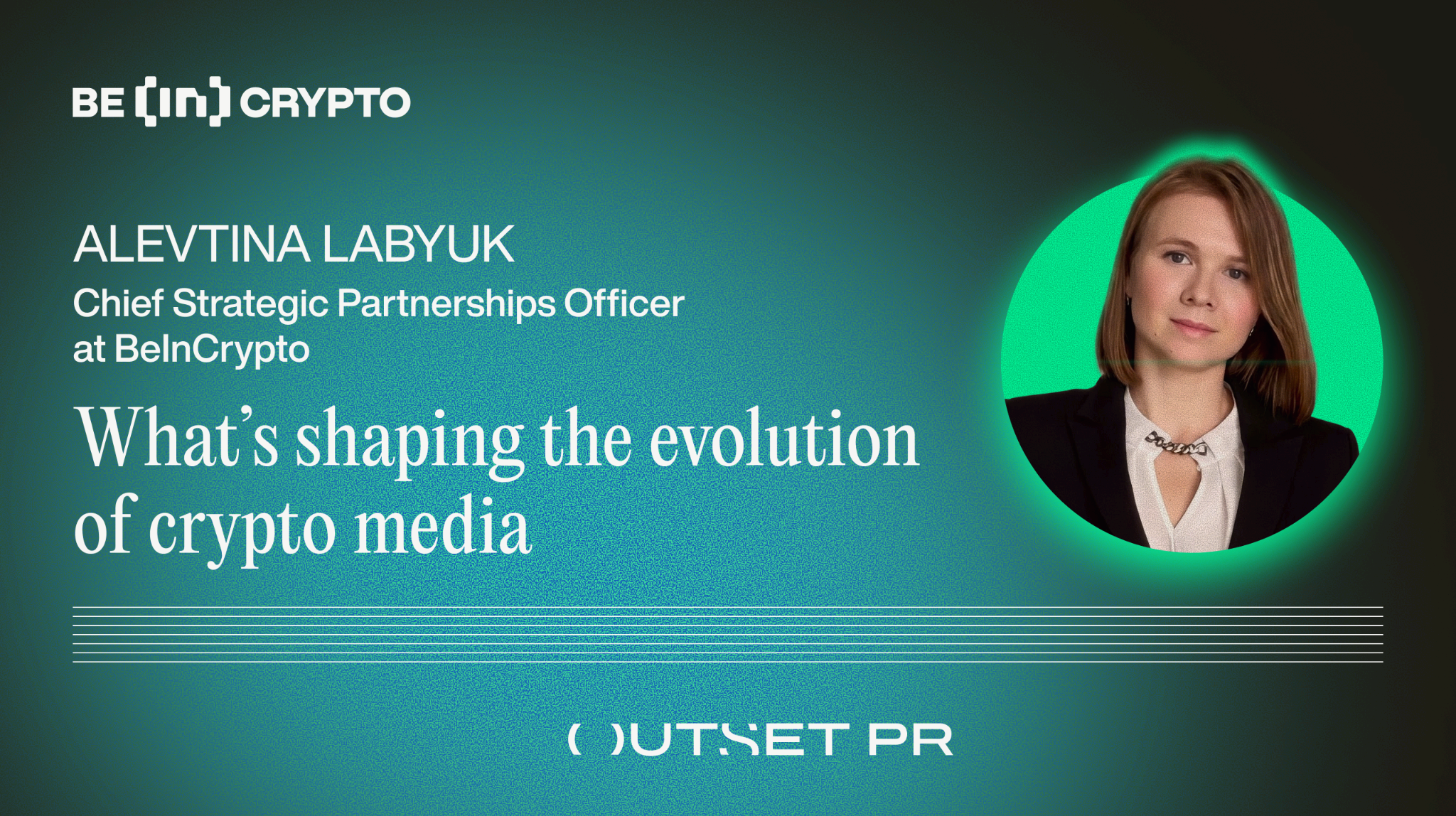
I wanted to understand how that balance works in practice: how BeInCrypto builds relationships with clients without compromising editorial integrity, what it can learn from those relationships, and how the role of media partnerships is evolving as LLMs reshape user behavior and the broader market changes with them.
Alevtina Labyuk has spent more than 15 years in marketing and PR. In 2022, she joined BeInCrypto in affiliate marketing and gradually expanded her role across commercial and strategic functions.
Reflecting on her progression from managing a single channel to thinking about the business as a whole, Alevtina pointed to two key drivers: the experience she had built doing marketing for global brands such as Visa and Club Med and BeInCrypto’s corporate culture, which rewards people willing to take on more and aim higher.
“I came in knowing how to build a user journey towards a goal. What happened next is just how this company works: whoever contributes the most gets moved forward.”
Today, Alevtina personally handles 30 to 40 tier-1 institutional client calls a month while working closely with editorial, product and leadership.
“When you collaborate with market leaders, you can't start from a format, – she explains. “You start from the client's business, from their narrative, from what it actually means to be a leader in their own segment.”
“Then our products pull in different directions. Retail formats have to bring traffic and become the last trigger before someone decides to go and try the product. Institutional formats are built on unique expert insights and business relevance.”
“And the conversations with leadership are almost always about the same balance: value for readers, who come from very different industries and segments, value for partners, and holding the standard of real journalism while we do it.”
Still, Alevtina sees client work as one of the privileges of her position, as it gives her the opportunity to talk to some of the largest companies in crypto and TradFi. Most of that work comes down to one decision, made over and over: who BeInCrypto builds with.
What companies expect from media depends on how they do business
According to Alevtina, a client’s corporate culture is something that defines how BeInCrypto works with different brands. And that culture depends on the type of product.
Exchanges tend to be highly results-driven, with trading volume as the clearest KPI. Protocol teams, usually loaded with engineers, are more likely to look for a repeatable formula: a certain number of articles, links and mentions that should produce a predictable outcome – they need technical content for their communities. Infrastructure businesses care more about reaching specific decision-makers.
Company size and maturity tell a less straightforward story. Younger infrastructure teams are increasingly built as what Alevtina describes as “all-star line-ups”, bringing together people from major exchanges or protocols, traditional businesses and agencies. They arrive with established connections and processes from their previous roles and can sometimes approach collaboration more systematically than larger organizations where “everyone owns a small piece and nobody owns the outcome.”
For Alevtina, the bigger differentiator is experienced management – people who understand how a business works, how results depend on the scope and responsibility of each function and how priorities are set.
“Because there are three most expensive types of marketing: chaotic marketing (‘this looks cool, let’s do it!’ – occasional one-off activities without a proper strategy), cheap marketing (‘let’s test it, but we only have $500 to spend’), and marketing focused on instant results (‘we’re just getting started — which format will bring us the most clients this month?’). It’s very difficult to achieve truly extraordinary and sustainable results with companies that take any of these approaches. That’s why we focus on long-term strategic collaborations.”
Most importantly, that kind of leadership acknowledges the importance of expertise and trust, recognizes that relationships take time, effort and mutual respect, and brings the same mindset to its own audience, whether B2C or B2B.
For Alevtina, some of the most revealing lessons have come from seeing companies rethink how they operate. The biggest shift occurs when they move from B2C to B2B: even with the same management in place, their priorities, activities and media strategy can look entirely different, often taking them beyond crypto publications and into traditional financial media. Following these transitions up close has shaped how she interprets what a partner is actually asking for.
Geography is also part of the partnership equation
Per Alevtina, geography influences both the problem a crypto business is trying to solve and the media content that makes sense around it.
Below are some of the factors at play across major GEOs:
- Europe and the US. Crypto is often positioned against a traditional banking system that is slow and expensive. In Europe specifically, regulation and old money add another layer, while audiences tend to favor polished, institutional-style reports.
- Asia. Legislative changes continue to reshape the local crypto industry. Businesses are increasingly looking toward emerging markets such as Vietnam and Indonesia, as well as parts of Africa. Content preferences skew toward shorter formats, with flash news particularly popular in China.
- Latin America. Inflation remains an important driver of crypto adoption. Readers respond strongly to visual formats and storytelling.
- MENA. Communication requires extra sensitivity to how content may be interpreted by government bodies, making the broader regulatory and institutional context part of the editorial calculation.
For a global media outlet, localization therefore goes beyond translating the same story. BeInCrypto publishes in 26 languages, and Alevtina says the underlying approach also has to adapt to the specifics of the market, the company and its communication goals.
The right media strategy always starts with a client problem
Then our discussion turned to the development of new commercial formats. At BeInCrypto, they often start with a pattern in client conversations.
When multiple teams begin mentioning the same goals, problems or even the same events, it becomes a signal. BeInCrypto’s reports, for example, grew out of demand from businesses looking to establish category leadership. Recurring interest around major industry events has also led the editorial team to work directly with organizers and send journalists on the ground, including to Davos and Money20/20.
Alevtina notes that the process works best when the conversation starts with the actual business need rather than a predetermined deliverable.
“If the task is strategic, we go deep into the company. If someone comes to buy a format, they usually arrive with a complete picture in their head.”
She also shares that client input informs the strategy alongside changes in the market and the requirements of platforms like ChatGPT and Google and distribution partners such as CoinGecko, Yahoo Finance and TradingView. Thus, nearly all of BeInCrypto’s products have evolved over time, from interviews and reports to reviews, awards and even press releases.
The feedback loop is only effective if editorial standards stay intact
Alevtina believes that commercial feedback is valuable, but it can’t be allowed to dictate the editorial agenda. Ignoring either side creates its own problem.
“If a media company listens only to its clients, it turns into a cemetery of URLs: content nobody reads, packed with marketing messages. And if it goes too deep into creative journalism for its own sake, it loses contact with those who drive the market.”
The balance starts before a piece of content reaches production. Instead of trying to resolve an editorial-commercial conflict once the work is already underway, BeInCrypto looks for partners who already share their views and are similarly focused on where the market is going, rather than where the hype is today. Some categories, including casino, betting and gambling, are excluded altogether.
“It’s all about honesty toward our audience and with our own standards,” – Alevtina clarifies. “If what a client wants doesn't match how a professional journalistic outlet should behave, we won't work with them, however commercially attractive it looks.”
For the collaborations that do move forward, the basic requirements are simple: the content has to be trustworthy, high-quality and useful to the audience. BeInCrypto constantly tracks client expectations – what works, what falls short and what performs far better than expected – along the way, and those insights feed back into both product development and new partnerships.
Partners can point to market shifts before audience data does
Audience data is retrospective by nature: it shows what attracted attention. Partner conversations can reveal what companies believe will matter next before it becomes visible in traffic numbers.
On the retail side, publishers can see which formats and topics actually attract users and continue performing over time. Institutional clients offer another perspective through the deals they are pursuing, the markets they are entering and the narratives they are building around their future.
Alevtina recalls that a few years ago, BeInCrypto started covering ChatGPT, DALL·E and Midjourney while much of crypto media was still focused on ecosystem news. Partner conversations were already pointing toward AI as an important emerging direction. That early interest encouraged the publication to build deeper expertise around the topic. The newsroom was also among the first to write about quantum and the agentic economy.
However, not every emerging topic represents a groundbreaking shift. Alevtina highlights that there are always deeper economic, political or regulatory forces behind the signal.
“Legislation is always fundamental, because a change in the law changes the position of crypto in the market, and it decides which companies stay and which leave. We've seen that directly: several large exchanges shut down after failing to get a MiCA licence and lost their European users.”
Media’s next advantage is access, not just reach
What companies expect from media partnerships is evolving, and this is reflected most clearly in the questions they now ask. As Alevtina puts it, distribution and environment have moved ahead of raw volume.
“Four years ago it was ‘how many users?’ Today it’s ‘who’s in the room?’, especially in B2B: who will read this, which segments, which industries, sometimes which roles and which decision-makers.”
That growing scrutiny comes from tighter PR budgets as well. With less to spend, companies have become more selective about individual projects and partners, taking a closer look at the communications side of each collaboration.
The thinking around ROI has changed too. Alevtina refers to a period when the market swung heavily toward measurable returns, with companies expecting to know exactly what they would get for what they put in. But after seeing enough promises go unfulfilled, more experienced managers have become aware of how much in marketing remains outside their control.
“Marketing isn't a supermarket. You can't predict market moves, user behaviour, what competitors do or what regulators decide. Whatever anyone promises, instant business results don't exist.”
Looking two or three years ahead, Alevtina expects media partnerships to increasingly revolve around something harder to replicate: access. Newsrooms sit at the intersection of information flows, connecting companies with experts, data and conversations that may be difficult to reach elsewhere.
The rise of media-led conferences and events is part of the same development. Publications are becoming centers of professional communities, where participation can indicate that a company belongs to a certain circle of informed industry players.
Alevtina also thinks the relationship will become more reciprocal, as journalism, infrastructure and events all cost money.
“Media will be where valuable information gets distributed and a source of insights AI can’t generate, thanks to access to unique speakers and data providers. Companies that want to retain access to that information and those expert communities will increasingly seek long-term strategic collaborations with media outlets,” she concludes.


