
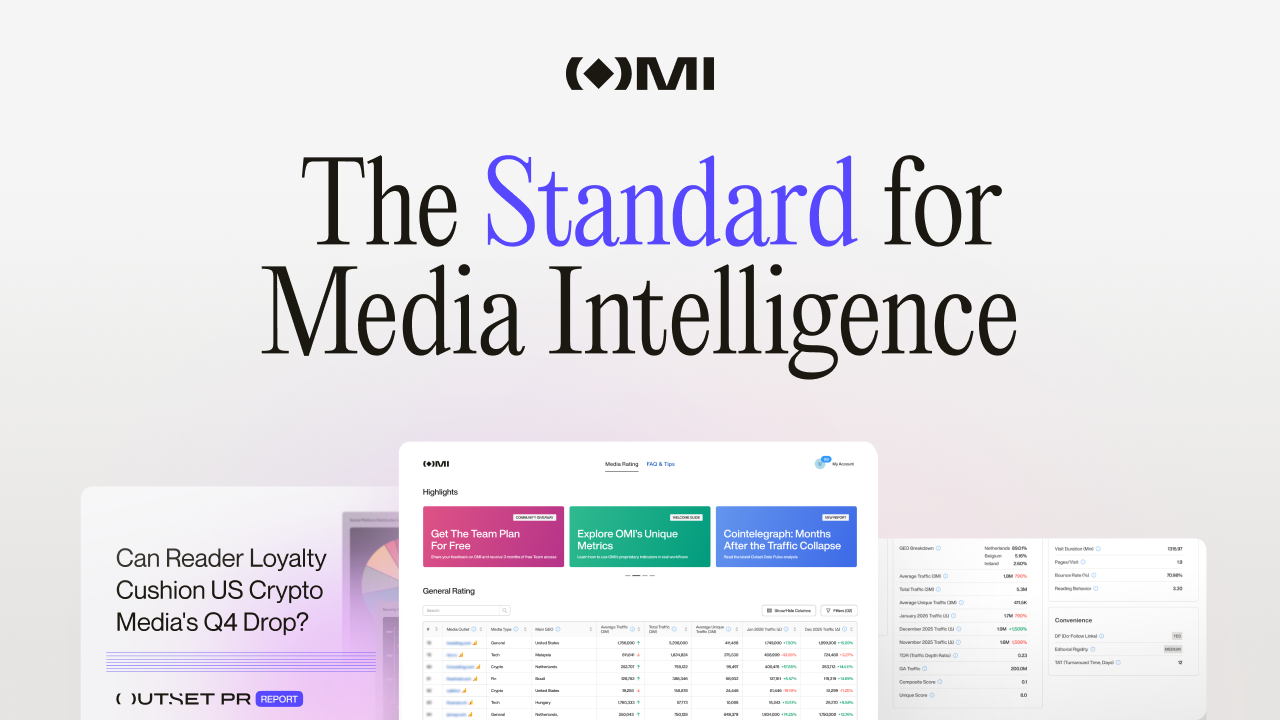
For years, working with media outlets has relied on intuition. Data lives across disconnected tools. Curated lists often hide affiliations with featured publications. Existing media monitoring systems have conflicting methodologies.
And results rarely map cleanly to effort or spend.
We’ve been inside the environment where what “worked” is often defined after the fact long enough to confirm the structural problem: the market lacks a shared reference point – one that advertising brands, PR agencies, and editorial teams can use to act confidently, grounding their growth strategies in hard data rather than assumptions.
And we built Outset Media Index to give teams exactly that – a standardized media intelligence benchmark designed to bring clarity and a uniform methodology to how media outlets are analyzed and compared.
The core strength of the index lies in its independence and analytical rigor. It organizes 37 decision-ready metrics across reach, engagement, SEO, and collaboration categories into a single dataset that can be adapted to different tasks, processes, and use cases.
The impartial methodology and unique indicators built for practical workflows
The methodology behind OMI is shaped by years of the team’s hands-on media work – on the PR agency side, on the brand side, and directly with editorial teams.
The index collects traffic, engagement, and SEO data from trusted providers such as Similarweb and Moz, alongside internal research tools developed to track how coverage travels across the media space. Raw data is carefully reviewed, normalized and combined into several weighted parameters to simplify benchmarking while filtering out inflated values and inconsistencies between sources.
The result is a well-founded methodological framework that applies to all indexed outlets without exception. OMI operates through two complementary scoring logics:
- General Rating – shows how strong an outlet is overall compared with other publications on the list. Each outlet’s rating position (GRP) is defined by the General Score that aggregates core performance indicators into one usable 1-100 metric.
- Convenience Rating – ranks publications based on their operational comfort. Positions in this rating (CRPs) are determined by the Convenience Score, another 1-100 parameter that considers factors such as editorial flexibility, turnaround speed, price-to-reach ratio, and more.
Beyond familiar Similarweb and Moz signals, OMI includes proprietary metrics designed to capture hidden media dynamics. Alongside the General Score and Convenience Score, these include:
- Unique Score – helps separate outlets with durable readership from that driven by short-lived traffic spikes.
- Reading Behavior – indicates where users truly engage with content after they arrive.
- Composite Score – identifies outlets with real growth momentum rather than temporary attention bursts
- Reprints – signals which publications can serve as primary coverage amplifiers.
- Editorial Rigidity – shows the level of editorial control that applies to submissions from external contributors.
Together, these parameters quantify traffic stability, audience quality, syndication depth, and ease of collaboration.
OMI’s methodology remains fixed and non-negotiable. Neither GPR nor CRP can be adjusted upon request, and visibility in both rankings is never influenced commercially. Every outlet is consistently processed through the same scoring system.
The product design that fits directly into daily media work
With OMI, teams can sharpen their decision-making by removing busywork from their day-to-day operations.
Flexible filters reduce sorting time and enable targeted benchmarking by applying parameters linked to the most relevant business goals – including geography, language, domain authority, reading behavior, and pricing.
Users can also tune the dataset to the task at hand. Columns can be shown or hidden to focus only on the metrics that matter in a given moment.
Each outlet is supported by a detailed Media Profile page that brings all performance and convenience-related factors together while adding historical data for contextual understanding, pattern recognition, and evidence-based forecasting.
When planning placements in a specific outlet, users can request coverage details directly through its Media Profile.
OMI under real-world constraints
Media teams rarely operate under ideal conditions. Budgets are limited, new markets require careful entry, and high-pressure moments demand reliable choices. OMI helps teams inform decisions in situations like these, making it possible to:
- Exclude low-impact or vanity placements and prioritize publishers that deliver measurable influence.
- Filter outlets by GEO and language, validate local traction, and review historical performance before committing spend.
- Amplify visibility strategically by showing how coverage travels beyond the original publication through reprints and broader media momentum.
- Choose credible, discoverable, and responsible outlets to move quickly without compromising reputation.
The interpretation layer: Outset Data Pulse is becoming OMI’s research branch
In 2025, we launched Outset Data Pulse (ODP) as the first organized attempt to analyze crypto media performance across markets. Today, ODP is undergoing a rebranding effort to provide meaningful context to OMI’s data.
Through periodic reports, the research team behind ODP examines traffic movements, user search behavior, editorial policy shifts, and other important dynamics to reveal regional visibility trends and discovery patterns. The goal is to translate OMI’s metrics into action-ready insights.
Sofia Belotskaia, the product lead of Outset Media Index, puts it like this:
“While OMI standardizes how outlets are analyzed to show what changes, ODP explains what these changes mean for media professionals – and how to act on them without wasting time and resources on guesswork.”
From now on, all free ODP reports will be accessible via a dedicated Substack feed.
The reference intelligence to take control of media markets
OMI translates strategic research discipline and practical campaign planning into a unified approach to media analysis that anyone can use – without needing to reconstruct the underlying complexity.
According to the Outset PR founder Mike Ermolaev, that means media operations are becoming more transparent, conscious, and auditable.
“Outset Media Index establishes the reference media intelligence layer, Outset PR provides the missing toolkit, and ODP extends it through expert-led interpretation. Together, all three entities create infrastructure for predictable and controlled media work,” he says.
Per Mike, the first release of OMI marks the emergence of a broader data-driven product ecosystem around Outset PR.
During the soft launch, the OMI team will closely cooperate with partners and early users: stress-testing the platform’s core functionality, interface clarity, and scoring logic under real working conditions – and refining the overall product experience before the full public rollout.
Any professional running media operations can join the index, share their feedback, and even participate in dedicated customer development interviews in exchange for a reward from the OMI team. More on this here.
Subscribe to Outset Media Index’s socials to keep up with the latest product updates: follow the X profile and join the Telegram channel.


