
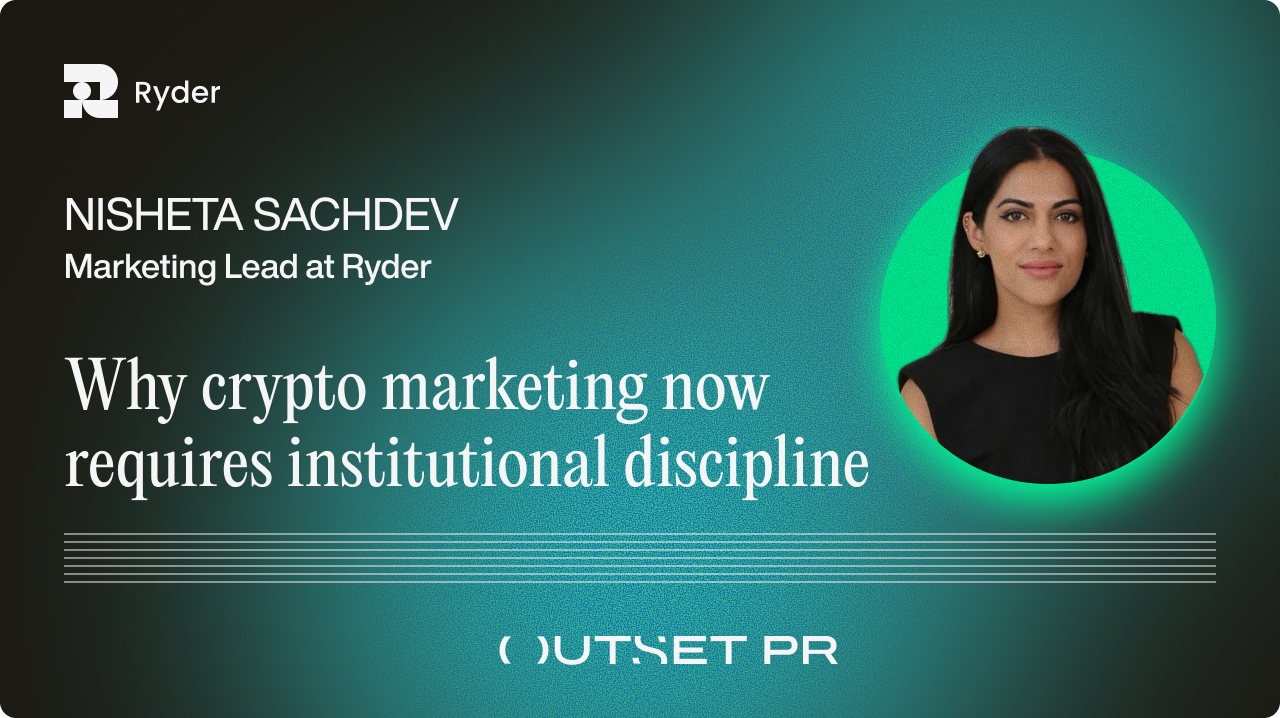
At Outset PR, our business discussions with partners often evolve into something far more interesting: an exchange of perspectives on how the industry is shifting, how narratives are rebuilding, and why traditional approaches no longer work in an environment that reinvents itself every cycle. Some of these conversations are too thoughtful to stay private. That’s why I’m sharing them as focused one-on-ones with people who don’t just do PR and marketing – they read the market, interpret its signals, and adapt strategy accordingly.
Nisheta Sachdev entered crypto when the technology felt like an experiment. Looking back, she describes the industry’s evolution with mixed emotions. On one hand, crypto has achieved what once seemed unrealistic: broader adoption, mainstream visibility, and corporate integration. At the same time, scams still feel baked into the culture.
Yet she believes the core promise of blockchain is finally starting to materialize – and that the next stage of growth will belong to teams that can build trust.
From agency hustle to brand accountability
Before joining Ryder as marketing lead, Nisheta spent years inside the agency world – including her time leading Luna PR. It was the kind of environment where marketing is built in real time: constant pressure, constant context switching, and always another campaign to ship. All of that shaped how she thinks about leadership:
“As a start-up, your team can really make or break your company. Managing that team is a skill that takes time to master, and the best managers continue to learn and adapt.”
And if there’s one mindset Nisheta believes separates strong leaders from average ones, it’s the ability to take feedback without ego.
“Learn to love criticism, or at least deal with getting it. If you take it properly and learn from it, feedback is the best way to grow and the quickest path to success.”
Staying consistent, even when it feels like nothing works unless it goes viral, was another important lesson she took from her agency background.
“It’s easy to feel like you’re not making an impact, especially in an industry that moves so fast. The truth is, growth takes time and requires discipline.”
When asked about the biggest surprise of moving in-house, Nisheta explains that agency work often only scratches the surface of full strategy development and execution. Inside a brand, she says, everything becomes heavier.
“Here, marketing is a lot more impactful, slower-paced, and highly strategic. Each post and email needs to align with the broader business direction. Every partnership and effort any team member takes needs to reinforce the overarching company vision.”
What good marketing means for crypto in 2026
For Nisheta, the definition of good marketing has shifted alongside the industry’s maturity. In 2026, pure hype is no longer a strategy. “Good marketing involves building trust, awareness, and growing a loyal following for the brand,” she clarifies.
For a self-custody product like Ryder, that means education first. The focus is not just on selling devices, but on explaining why self-custody matters in a market where major losses to hacks continue year after year.
Meanwhile, Nisheta acknowledges the reality of the attention economy. “We’ve become so addicted to content that all marketing forms are now content-driven,” she says. But being content-driven doesn’t automatically translate into effective marketing. The key is making the audience feel emotionally invested.
This is where many crypto teams get it wrong.
One of the most common mistakes Nisheta sees in user acquisition is the airdrop-first go-to-market model. The logic is simple: reward people for showing up, and growth will follow. But as she puts it bluntly, “Pay peanuts, get monkeys.”
When acquisition is built solely on incentives, it attracts short-term participants rather than committed users. Bots, reward hunters, inflated metrics – and very little meaningful engagement. The numbers may look impressive at launch, but retention collapses as soon as the rewards disappear.
In Nisheta’s view, campaigns should invite participation. When users are asked to vote on names, features, or small brand details, they begin to feel ownership. And ownership is what turns users into long-term advocates.
PR as trust infrastructure in a mature market
At a time when people are overloaded with information and trust is fragile, the real question is whether communication builds credibility over time. That’s why Nisheta argues that PR is as important as ever. For brands, it’s one of the few tools capable of consistently reinforcing long-term reputation, especially in an industry where skepticism is the default.
“PR becomes a trusted layer of interpretation in moments when the market needs clarity.”
And in 2026, PR has become much harder to fake. Nisheta draws a clear line between meaningful activity and empty exposure: “It’s only noise when there’s no strategy behind the public relations efforts.”
That’s where market maturity becomes visible. PR can no longer exist as a standalone function – it has to operate as part of a broader growth system. At Ryder, effectiveness isn’t measured by the number of mentions a campaign generates, but by whether those mentions contribute to tangible business outcomes.
“Our goals are SEO, brand awareness, credibility, and brand recall. But ultimately, all roads lead to Rome – and for us, that means user acquisition.”
The funnel is straightforward: SEO drives awareness, awareness builds credibility, credibility strengthens recall, and recall converts into acquisition. PR is the connective infrastructure linking those layers.
Why crypto narratives don’t move markets the way they used to
There was a time when a single crypto-native headline could move the market within hours. Today, even major announcements often feel “priced in.” Nisheta sees this shift as a structural evolution rather than a loss of relevance.
“Yes, a lot of the news is priced in,” she admits. “But we did ask to be here. As an industry, we wanted mass adoption – and for us, that meant ETFs and institutional participation.”
Now that those vehicles exist, funds flow differently. Bitcoin and other majors are increasingly influenced by liquidity conditions and broader risk appetite. With institutional money comes deeper pools of capital – and more measured reactions.
The market has also fragmented dramatically. “We’ve gone from having less than 10,000 tokens in 2021 to more than 20 million today,” Nisheta notes. Liquidity that once rotated through a relatively small universe is now spread across an enormous surface area. That dilution makes synchronized, narrative-driven bull runs far less likely.
Still, she cautions against equating lower volatility with stagnation. Expectations shaped by the explosive 2021 cycle may have distorted what sustainable expansion actually looks like. In a more mature crypto sector, narratives still matter – but they don’t override capital structure anymore. That may be a sign the market is finally growing up.
Crypto asked for institutional legitimacy – now it has to operate with discipline
Crypto spent years fighting to be taken seriously. It pushed for ETFs, institutional adoption, and mainstream legitimacy – and it got exactly that.
But with that shift comes a new reality: the market no longer rewards hype the way it once did. My conversation with Nisheta Sachdev only reinforced that the industry is entering a phase where credibility, structure, and long-term trust matter more than short-term narratives and random visibility spikes.
In that sense, the logic is simple: crypto wanted institutions. Now it has to behave like one.


